We can define CTL formulas as below:

where
....• The symbol  means truth value ‘true' and symbol
  means truth value ‘false'.
....• P ranges over a set of atomic propositions
We can notice here that each of the CTL temporal connectives is a pair of symbols. The first element of the pair is either of A or E ; A implies ‘along All paths' ( inevitably ) and E means ‘along at least (there Exists) one path' ( possibly ). The second element of the pair is X, F, G, or U , meaning ‘neXt state,' ‘some Future state,' ‘all future states (Globally)' and Until, respectively. The syntax of CTL demands that each temporal operator must be preceded by a path quantifier. X, F, G, or U must be preceded by A or E. Similarly, A or E must be followed by X, F, G, or U. In A[ φU φ ], A is followed by U and in E[ φ U φ ], E is followed by U.

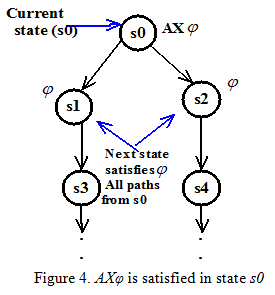
......• AXφ: A state (s0 in example of Figure 4) is marked AXφ if in all paths starting from that state (s0) the next state satisfies φ.
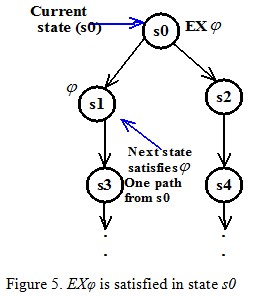
• EX φ : A state (s0 in example of Figure 5) is marked EX φ if there is at least one path starting from that state (s0) where the next state satisfies φ.
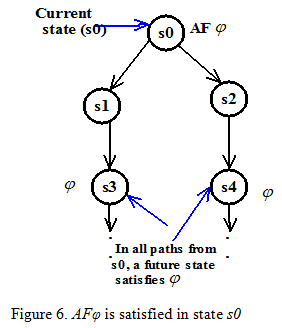
• AFφ: A state (s0 in example of Figure 6) is marked AFφ if in all paths from that state (s0) there is a state in future (s3 and s4 in the example) where φ is satisfied.