| Introductory definitions for photographs
|
| Vertical photograph
|
| A photograph taken with the optical axis coinciding with direction of gravity.
|
| Tilted or near vertical
|
| Photograph taken with optical axis unintentionally tilted from vertical by a small amount (usually < 3°)
|
| Focal length (f)
|
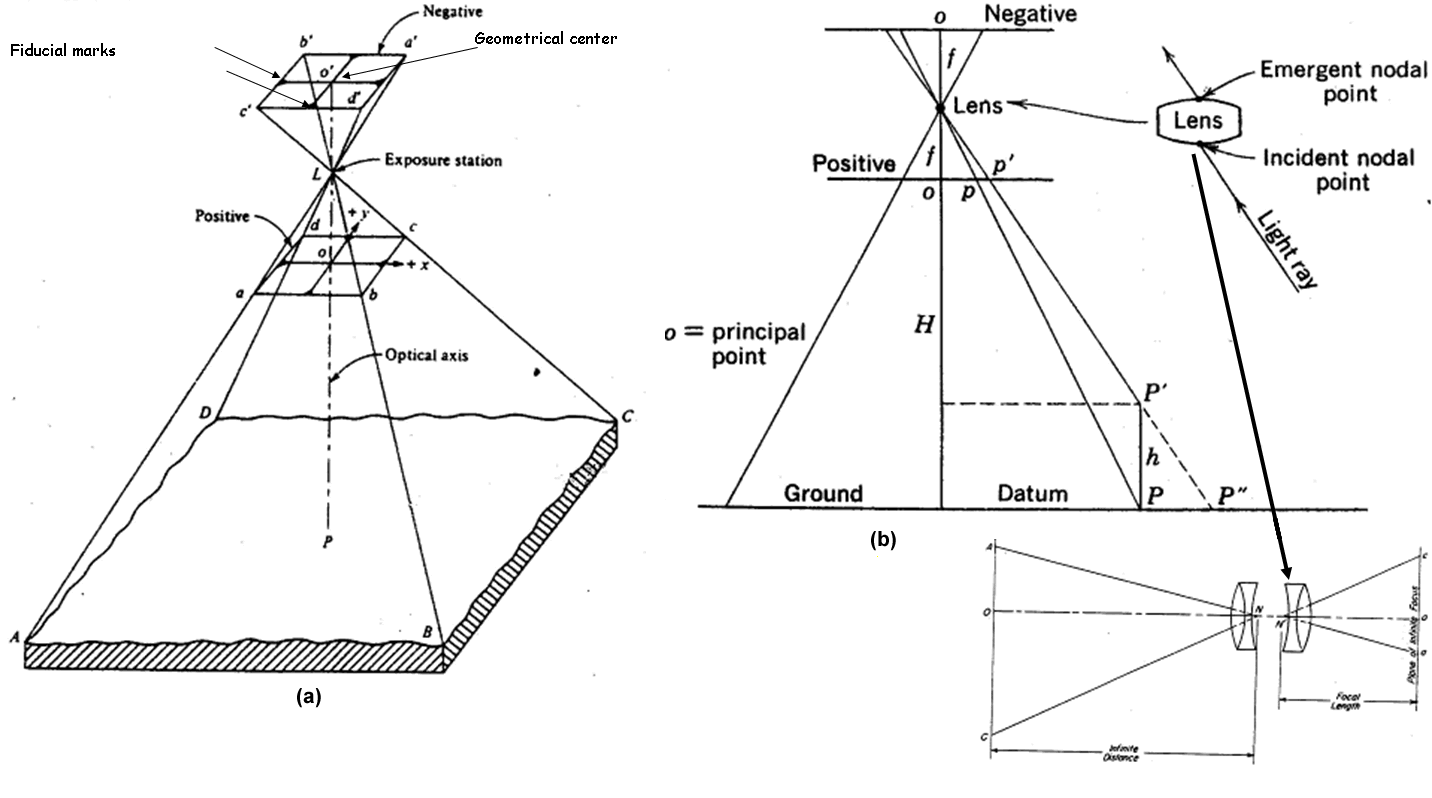
| Distance from front nodal point to the plane of the photograph (from near nodal point to image plane).
|
| Exposure station (point L)
|
| Position of frontal nodal point at the instant of exposure (L)
|
| Flying height (H)
|
| Elevation of exposure station above sea level or above selected datum.
|
| |
Click on the figure for a larger view
|
| Figure 3: Aerial photographs showing various elements as defined
(a) Elements of vertical photograph (b) Section of imaging geometry showing various elements
|
| |
X-axis of photo
Line on photo between opposite collimation marks, which most nearly parallels the flight direction.
|
Y-axis
Line normal to x-axis and join opposite collimation marks.
|
Principal point (o)
The point where the perpendicular dropped from the front nodal point strikes the photograph or the point in which camera axis pierces the image plane.
|
Camera axis
It is a ray of light incident at front nodal point in the object space and at right angles to the image plane.
|
Fiducial marks or collimation marks
Index marks usually four in number, rigidly connected with the camera lens through the camera body and forming images on the photographs to which the position on the photograph can be referred.
|
Photographs center
The geometrical center of the photograph as defined by the intersection of the lines joining the fiducial marks.
|
Format
It is the planar dimension of photograph (9" x 9", 7" x 7", 23 cm x 23 cm, 18 cm x 18 cm, 15 cm x 15 cm).
|
| Photogram
Photograph taken with a photogrammetric camera having fixed distance between negative plane and lens and equipped with fiducial or collimating marks. For photograms the bundle of rays on the object side at the moment of exposure can be reproduced. To achieve this the following data known as the elements
of interior orientation must be known:
|
- Calibrated focal length
- Lens distortion data
- Location of the principal point with reference to the photograph center (normally these two coincide)
|
| Hence, a photogram is a photograph with known interior orientation
|
| Difference between near vertical photographs and map
|
- Production : Quickest possible and most economical method of obtaining information about areas of interest. Boon for difficult areas. Enlarging and reducing easier in case of photographs than maps.
- Content : Map gives an abstract representation of surface with a selection from nearly infinite number of features on ground. Photograph shows images of surface itself. Maps often represent non-visible phenomenon (like text) This may make interpretation difficult for photograph. Special films like color and infrared films can bring about special features of terrain.
-
Metric accuracy: Map is geometrically correct representation, photos are generally not. Maps are orthogonal projections, photo is central projection. Map has same scale throughout photo has variable scale. Bearing on photographs may not be true.
-
Training requirement: A little training and familiarity with the particular legend used in the map enables proper use of map. Photo-interpretation requires special training although initially it may appear quite simple as it gives a faithful representation of ground.
|