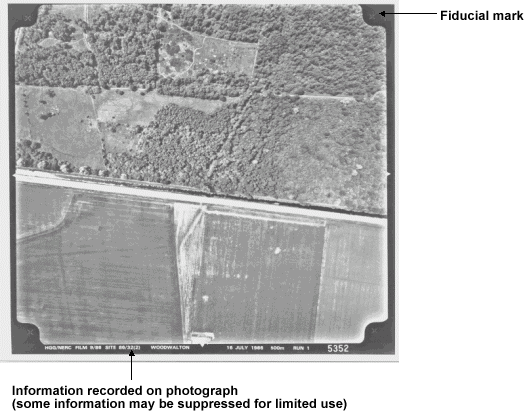
The following information is recorded on a typical aerial photograph
Fiducial marks for determination of principal points.
Altimeter recording to find flying height at the moment of exposure.
Watch recording giving the time of exposure.
Level bubble recording indicating tilt of camera axis.
Principal distance for determining the scale of photograph.
Number of photograph, the strip and specification no. for easy handling and indexing.
Number of camera to obtain camera calibration report.
Date of photograph
Figure 1: Typical aerial photograph
Types of projections
Parallel : The projecting rays are parallel.
Orthogonal : Projecting rays are perpendicular to plane of projection. This is a special case of parallel projection. Maps are orthogonal projection. The advantage of this projection is that the distances, angles, and areas in plane are independent of elevation differences of objects.
Central : Central projection is the starting point for all photogrammetry. In this projection rays pass through a point called the projection center or perspective center. The image projected by a lens system is treated as central projection although in strictest senses it is not so.