Module 2 : Global Positioning System
  Lecture 9 : GPS Errors and Accuracy
Satellite clock bias
There are two problems with satellite clocks (Sickle, 2001):
   (a) relativistic effect
   (b) clock drift
 
(a) Relativistic effect
From theory of relativity, clock in orbit will appear to run faster than on earth (more speed and weaker gravitational force). It results in two effects:

(1) First effect:
One has to take into account the time dilation before satellite is sent to orbit. To ensure that clocks will actually achieve the fundamental frequency of 10.23 MHz, the frequency is set a bit slow before launch (10.22999999545 MHz).

(2) Second effect:
It is attributable to eccentricity (0.02) of orbit causing time error of 45.8 ns. This error is corrected in GPS receiver itself avoiding an error of about 14 m.

(b) Clock drift
  • Each GPS block II and IIA satellites have four high quality atomic clocks, two cesium and rubidium atomic clocks. One of the cesium clocks is used for time-keeping and signal synchronization as they behave better compared to rubidium clocks; others are backups.
  • Stability of GPS clocks:
    • Rubidium clocks: 1 to 2 parts in 1013 over a period of one day or about 8.64 to 17.28 ns per day
    • Cesium clocks: stability improves to 1 to 2 parts in 1014 over 10 days
    • Hydrogen masers: 1 part in 1014.
  • Unavoidable temporally variant clock errors are source of a significant bias which are monitored by the control segment during tracking data analysis. The primary purpose of clock correction is to reduce error from about 1 ms of satellite clock error to around 30 ns of GPS time. It may be noted that the concept of carefully measured and monitored time is central to proper functioning of GPS. However, description of concept of time is outside the scope of these lectures. Interested readers can refer to Time System for more information on time systems relevant for GPS.
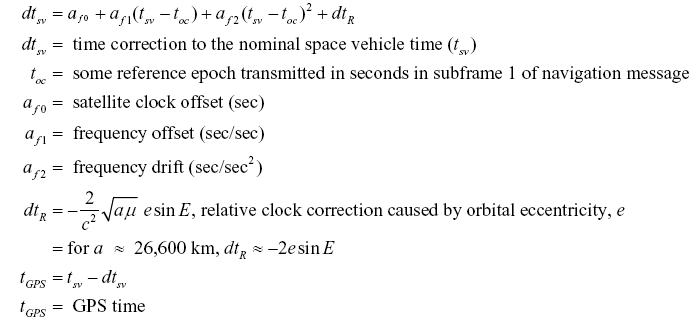
  • MCS gathers GPS satellite data from 5 monitoring stations. After processing, this information is uploaded back to each satellite to become the broadcast ephemeris, broadcast clock correction, etc. In single receiver positioning, satellite clock errors are accounted for by using the broadcast clock error model defined by three polynomial coefficients and are transmitted in navigation message. For more details on this one can refer to Interface Control Document. Using these coefficients, the time correction can be carried out as given below:
  • t sv must account for the beginning or end of week crossovers
  • Three polynomial coefficients are known well enough to match the basic pseudo-range accuracy up to a few meters. However, even applying these corrections leaves error of the order of several nanoseconds equivalent to a range error of approximately 30 cm.
  • All observations made at an instant, to a particular satellite, by all GPS receivers, are contaminated by the same satellite clock error. Hence, this bias can be removed through differential positioning .
  • Onboard satellite clocks are independent of one another. Clock oscillators are more stable if these are not disturbed by frequent tweaking and adjustment is kept to minimum. Hence, rather than interfering with clocks, it is better to model their behavior through careful monitoring and provided through polynomial coefficients.
  • Leap seconds are used to keep Coordinated Universal Time (UTC) (as determined by US Naval Observatory ( USNO) ) correlated with earth rotation. Leap seconds are ignored with GPS time which assumes as if no leap seconds at all in UTC after 24:00:00, January 5, 1980.
  • GPS time is designed to be kept within one ms of UTC (as per the USNO, excepting leap seconds). In reality, GPS time is normally within 40 ns of UTC. Satellite clocks are allowed to drift up to one ms from GPS time and then corrected.