Construction of concrete slab
General
The concrete surfacing could be made up of plain concrete or reinforced concrete. Reinforced concrete has been discussed later in a different lecture. The proportions between cement, aggregate and water is determined by standard concrete mix design technique.
Premature setting and segregation
is to be avoided while transporting the concrete
mix through the access haul road and continuous stirring
may be helpful in such a case. The spreading of concrete
should be done uniformly such that no segregation
of materials takes place. A separation membrane,
made up of impermeable plastic/ polyethylene sheet
(of thickness of the order of 150 micron) is sometimes
laid over the sub-base, without creases, on to which
concrete slab is laid (IRC:15 2002). Figure-34 presents
a photograph of laying polyethylene sheet over DLC.
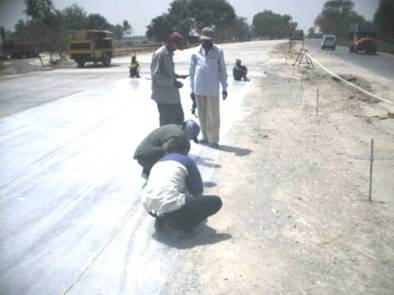
Figure-34 Laying
of polyethylene sheet over DLC ( photo courtesy:
Mr. Ashutosh Gautam, Project Director, NHAI, Kanpur )
Compaction and surface finishing
Concrete is spread evenly and is rodded with suitable equipment such that formation of honey-combing or voids can be avoided. At the same time, over-compacting needs to be avoided, which can cause segregation and loss of entrained air ( Swanlund and Vanikar 2002 ). The working of fixed form and slip form pavers are different - and has been discussed briefly in the following:
Fixed form paving system
In fixed-form paver system, generally, separate powered machines for spreading, compacting and finishing are used. The spreader spreads concrete evenly through reversible auger to the desired surcharge level (O'Flaherty 2002). The rotary strike-off paddles trim minor irregularities in the surface of the surcharge concrete and adjusts with the carriage-way cross-slope . The compaction beam applies vibration to the concrete with pre-designed amplitude and frequency (O'Flaherty 2002). This vibration also helps to put the dowel and tie bars at their desired positions (for a single layer construction).
The wet formed joint groove is made by introducing vertical cut immediately after compaction is over and inserting a preformed cellular permanent strip . As an alternative, saw joint groove can be made after the concrete is sufficiently hardened and can maintain the sharp edge itself (O'Flaherty 2002).
The finishing of the surface is made, generally, with a pair of finishing beams . The leading beam vibrates and smoothens the surface, and the rear beam acts as float . The beams are oriented obliquely so that it causes less damage to the joints (O'Flaherty 2002).
Slip form paving system
Slip-form paving machine is a self-propelled
system that can automatically spread, trim, compact
and finish the surface in a synchronized manner
through its feedback sensors. Placing of dowel/ tie
bars at their pre-designed locations are done by
the slip-form pavers. The introduction of joint grooves,
surfacing texturing and spraying of curing compound
etc. are done by the equipment those follow
the paver (O'Flaherty
2002).
Slip-form paver requires guide-wires,
parallel to edge of construction and maintained at
fixed height, installed on the both side. The alignment
of the slip-form paver is controlled automatically
with respect to the guide-wires. Correct and precise
alignment of the guide-wires is therefore extremely
important. The hopper/ spreader maintains a constant
surcharge of the concrete above the conforming plate
level. The conforming plate, vibrators, strike off
paddles and the finishing screed gives the final
shape of the concrete pavement (O'Flaherty 2002).
Figure-35 explains schematically the operation of
a typical slip-form paver, and Figure-36 a photograph
of concrete pavement construction by a slip form
paver.
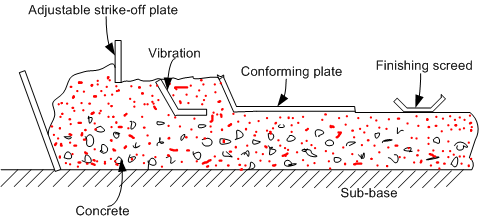
Figure-35 Schematic
diagram explaining operation of a typical slip-form
paver
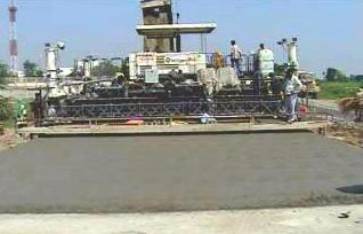
Figure-36 Construction of
concrete pavement slab with slip-form paver ( photo
courtesy: Mr. Ashutosh Gautam, Project Director,
NHAI, Kanpur )
|


