Shock Waves
Example
Traffic is moving on a one way road at qA = 1000 vph , and kA = 16 vpkm. A truck enters the stream at a point P (which is at a distance of 1 km from an upstream benchmark point BM) at a speed of uB = 16 kmph. Due to the decreased speed the density behind the truck increases to 75 vpkm. After 10 minutes, the truck leaves the stream. The platoon behind the truck then releases itself at capacity conditions, qC = 1400 vph and kC = 44 vpkm. Determine
(i) the speed of all shock waves generated
(ii) the starting point of the platoon (behind the truck) forming shock wave
(iii) the starting point of the platoon dissipating shock wave
(iv) the ending points of the platoon forming and platoon dissipating shock waves
(v) the maximum length of the platoon, and
(vi) the time it takes for the platoon to dissipate, and also plot the
(vii) location of the front of the platoon and the rear of the platoon versus time, and
(viii) length of the platoon versus time.
Solution
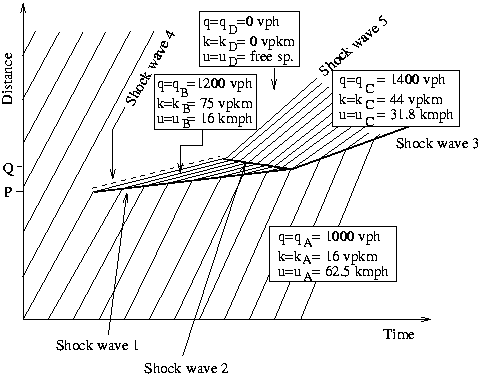
Consider the distance-time diagram shown in Figure 4 plotted for the scenario described in the problem. This diagram is shown here to help the reader understand the problem better; strictly speaking the complete diagram is not necessary for solving the problem. However, an understanding of the physical scenario is of definite help.
Fig 4: Distance time diagram illustrating the example problem on shock waves.
 |
(i) Speeds of the various shock waves generated (shock wave  is denoted as SW) can be obtained directly by using Equation 1 as follows: is denoted as SW) can be obtained directly by using Equation 1 as follows:
 |
= |
 |
= |
 |
= |
3.39 kmph |
| |
|
|
|
|
|
|
 |
= |
 |
= |
 |
= |
-6.45 kmph |
| |
|
|
|
|
|
|
 |
= |
 |
= |
 |
= |
14.29 kmph |
| |
|
|
|
|
|
|
 |
= |
 |
= |
 |
= |
16 kmph |
| |
|
|
|
|
|
|
 |
= |
 |
= |
 |
= |
31.8 kmph |
(ii) Shock wave 1 is the platoon forming shock wave. It starts at Point P and at the time when the truck enters the stream.
(iii) Shock wave 2 is the platoon dissipating shock wave. It starts at Point Q (i.e., where the truck leaves the stream) and 10 minutes (note the truck remains in the stream for 10 minutes) after the truck entered the traffic stream. Point Q is 16 x (10/60) = 2.67)
km downstream of Point P.
(iv) Both shock waves 1 and 2 will end if the platoon condition (i.e., condition B) ends. This condition will end whenever Shock waves 1 and 2 meet. Say they meet at time t hours after the start of Shock wave 1, where their positions must be the same. Their positions at time  can be determined from their starting positions and distances by which these travel during time t. Thus, knowing that P is 1 km from BM and Q is 3.67 km from BM, one can write the following can be determined from their starting positions and distances by which these travel during time t. Thus, knowing that P is 1 km from BM and Q is 3.67 km from BM, one can write the following
or,
Hence, the two shock waves end 22.84 minutes after the start of Shock wave 1 and at a distance of
1+ 3.39 x 0.381 = 2.29 km downstream of BM.
(v) The maximum length of the platoon will be at the instant where Shock wave 2 is just about to start. The platoon at any given time is defined by the length between the front of the platoon (Shock wave 4) and the rear of the platoon (Shock wave 1). Hence, the length of the platoon grows at a speed of 16 - 3.39 = 12.61kmph. The length is maximum at 10 minutes after the platoon starts forming. Hence the maximum length is equal to
12.61 x (10/60) = 2.1 km. In terms of number of vehicles the maximum length of the platoon is
kB x 2.1=
75 x 2.1=157.5 ≈ 158 vehicles.
(vi) In part (iv) it was determined that the platoon ceases to exist 22.84 minutes after the start of platoon formation. Out of this for the first 10 minutes the platoon only grows (and there is no dissipation). Hence it takes 12.84 minutes for the platoon to dissipate.
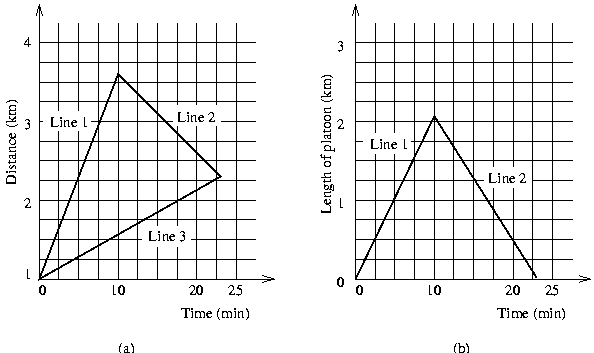
(vii) Figure 5 (a) shows the required plot. In the plot, time is assumed to be zero when Shock wave 1 starts; the distances are as measured from BM. In the figure, Lines 1 and 2 represent the front of the platoon and Line 3 represent the rear of the platoon. Further, the slope of Line 1 is equal to USW4 , the slope of Line 2 is equal to USW2 , and the slope of Line 3 is equal to USW1.
(viii) Figure 5 (b) shows the required plot. In the plot, time is assumed to be zero when Shock wave 1 starts. Slope of Line 1 is equal to the rate of growth of the platoon. This value, as determined in part (v), is 12.61 kmph. The slope of Line 2 is basically the rate of dissipation of the platoon; however, this need not be calculated since one knows the maximum length of the platoon and when the platoon completely dissipates.
Fig. 5: (a) Plot of platoon front and rear locations versus time for the example, and (b) Plot of length of platoon versus time for the example.
 |
|




