Field Application
The field method is similar to the laboratory technique described above. However, instrumentation of the field soil is complicated, especially for estimating the conductivities of soils in natural condition. Nevertheless, the estimation of hydraulic conductivities has been widely used across several groups of soil science and engineering. Watson (1966) and Hillel et al. (1972) described the method based on water draining/desorption under the gravitational gradient while the infiltration and evaporation at the surface are restricted. In contrary, Meerdink et al. (1996) studied the retention and hydraulic behavior of fine-grained soils due to evaporative fluxes from the soil surface. A schematic diagram of the testing scenario is given in Fig 4.30, in which the field soil is instrumented with set of tensiometers for suction measurement at different spatial location and neutron probe access tube for measuring water content profile along the vertical depth. The instrumentation is done within berm boundary or infiltration ring within which the water is ponded.
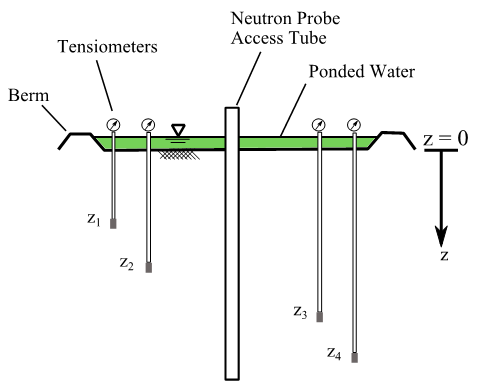
Fig. 4.30 Hydraulic conductivity testing in the field (after Benson and Gribb, 1997)