Instantaneous profile method
This is another commonly used indirect method of hydraulic conductivity estimation in both laboratory and field. The soil moisture content and matric suction distribution along the depth of the soil profile are measured at different time instants during the transient water infiltration or drainage process. The measurements at different time instants and multiple spatial locations provide redundant data for better analysis. Soil columns with either disturbed or undisturbed specimens are used in the laboratory and, on the other hand, an instrumented vertical soil profiles are used in the field for estimating hydraulic conductivity using this technique. The time dependent water diffusion and hydraulic gradients across the soil column are estimated from the observed time dependent profiles of either moisture content or matric suction. At least one profile is required and other one can be inferred from SWCC. In both the laboratory and field applications, Darcy's law is assumed to be valid for ease in the theoretical analysis. Laboratory and field application of the present technique is described in the following sections.
Laboratory Application
The laboratory instantaneous profile method was used by many researchers (Richards and Weeks, 1953; Chiu and Shackelford, 1998). The soil samples are confined in rigid-wall columns of 10 - 30 cm of length. The gravitational influence on the water flow is ignored for horizontally oriented column testing. The following schematic diagram in Fig 4.26 shows the typical laboratory soil column for water flow testing.
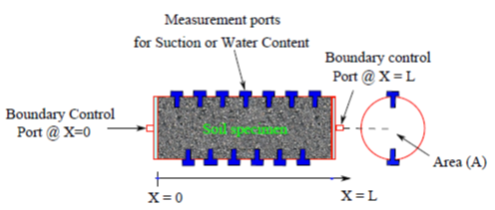
Fig. 4.26 Schematic diagram for laboratory column testing (after Lu and Lukos)