Interaction between air – water – solid phases
The air-water interface will curve to form a meniscus when it comes in contact with solid surface. The meniscus angle with the solid surface, measured in the water, are lower than 90 0 (acute contact angles) when adhesive forces between solid walls and water molecules dominate the cohesive forces between the water molecules, On the other hand, obtuse contact angle are observed when cohesive forces dominate the adhesive forces. Acute contact angles are typical for interactions between pore water and soil solid surfaces. The curvatures of the menisci generate water pressures lower or higher than the air pressure depending on whether the contact angle is acute or obtuse angle, respectively. Let us consider a capillary tube of diameter d immersed in a water body as shown in Fig. 3.3. The meniscus is concave on the air side with a contact angle θ , as shown in the same figure. The water pressure at the back of the meniscus can be calculated considering the vertical force equilibrium of the air-water interface. The resultant mathematical equation can be expressed as
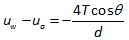 .......................................................................................(3.1)
where Uw is the water pressure just below the meniscus, Ua the air pressure, T the surface tension, and R the radius of curvature of the interface. If the contact angle is an acute angle (θ< 90° ), the gauge water pressure becomes negative, which is typical in soils. It can easily be verified the water pressures
across the menisci of different diameter capillary tubes as illustrated in the following example problem.
.........................................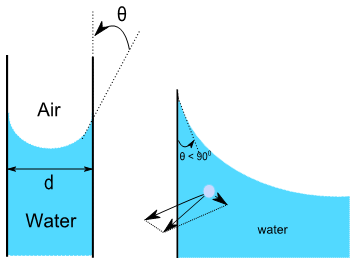
Fig. 3. (a) Curvature of the air-water interface in proximity of a solid surface (b) a closer look of the meniscus