Table 2 shows another variant of risk matrix, where risk rating is based on a numerical risk scale by assigning numerical values to the linguistic scales of probability and impact. As per the risk scale, if the product of probability and impact is greater than 50, it is rated as High, between 10 and 50 as Medium, and less than 10 as Low.
Table: 2 Probability/Impact Risk Matrix
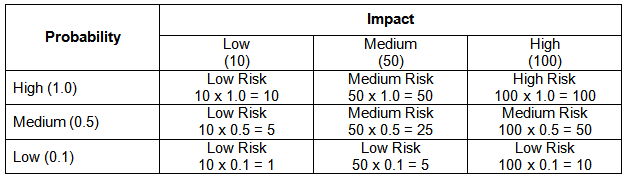
The risk ratings will guide the necessary risk management strategies to be adopted. For instance, using the above-mentioned risk matrix, if an identified risk is rated to be high risk, then it may priority action and aggressive response strategies.
The risk register containing the list of identified risks from risk identification stage is further updated with information on priority of risk obtained from qualitative analysis of risks.
QUANTITATIVE RISK ANALYSIS
Quantitative analysis is a process involving numerical techniques to evaluate and quantify the impact of risk on project objectives (like final cost and timescale of projects). The most widely used techniques for quantitative risk analysis include sensitivity analysis, and probabilistic risk analysis.
Sensitivity analysis is a deterministic modeling technique, which is used to test the impact of a change in the value of an independent variable on the dependent variable. Basically, it helps to answer ‘what if' questions, i.e. what will be the impact on project cost if the value of one of the independent variable is changed, while the remaining independent variables are held at their baseline values. Sensitivity analysis helps to determine which risks have the most potential impact on the project. It also helps to identify factors that are risk sensitive by testing which components of the project have the greatest impact upon the project outcome.
The methodology of sensitivity analysis is very simple. First a base case estimate using the data which has high probability of occurrence is formulated. Then step-wise changes are introduced in the independent variables one after another to test their effects on the dependent variables. Sometimes, changes in more than one independent variable are introduced to test the combined effect of the changes. These combinations are normally known as scenarios. The scenario which will emerge by considering beneficial cases for the the combined independent variables is known as best case scenario while the scenario which emerged by considering adverse cases for the combined independent variables is known as worst case scenario. The best case scenario and worst case scenario rarely occur in reality. However, the worst case scenario provides the bottom line reference for making the decision relating to the project acceptability.