Print this page
Kaolinite and halloysite clay minerals are the most common.
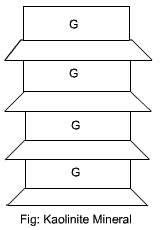
Kaolinite Mineral
The basic kaolinite unit is a two-layer unit that is formed by stacking a gibbsite sheet on a silica sheet. These basic units are then stacked one on top of the other to form a lattice of the mineral. The units are held together by hydrogen bonds. The strong bonding does not permit water to enter the lattice. Thus, kaolinite minerals are stable and do not expand under saturation.
Kaolinite is the most abundant constituent of residual clay deposits.
Halloysite Mineral
The basic unit is also a two-layer sheet similar to that of kaolinite except for the presence of water between the sheets.