Random Variables
A random variable may be defined as a variable whose values depend on the outcomes of a random experiment. In a more probabilistic sense it can be defined as follows;
‘If E is an experiment having sample space Ω and X is a function that assigns a real number X(e) to every outcome e E, then X(e) is called a random variable'.
Table 3.1: Outcomes of the ‘tossing the coin twice’ experiment
Outcome |
HH |
HT |
TH |
TT |
X |
2 |
1 |
1 |
0 |
The domain of X is the sample space Ω and the numbers in the range are real numbers. Table 3.1 is showing the outcomes of ‘tossing the coin twice' experiment and the associated sample space. The outcomes are not numbers hence using the random variable X(e), real numbers are attached to each of the outcomes which are also shown in the table. For random variable X(e), for every outcome e that belongs to the sample space there is exactly one value of X(e) = x, for example X(HH) = 2. As discussed earlier the range is made up of the possible values of X. In this example the outcomes are equally likely to occur and each has the probability of ¼. Different possible values for X, i.e. occurrence of different events which are the subsets of the sample space, have different associated probabilities (e.g. P(X=1) = ½).
Here onwards, the upper case alphabets are used to denote the random variables and the corresponding lower case alphabets are used to denote particular values taken by the random variables.
Discrete Random Variable
A discrete random variable takes countable number of values or the range is finite. In general a discrete random variable takes integer values but not limited to only integer values. Let X be a discrete random variable which takes the values x 1 , x 2 … , the function f(x) defined by f(x) = P(X = x) is called the probability function or the probability mass function of X.
Let f(x) is the probability function of a discrete random variable X. then we have
.png)
.png)
Properties of the probability mass function
1. The probability of a discrete random variable X taking a specific value x is p(x).

2. P(x) is non-negative for all real x.

3. The sum of p(x) over all possible values of x is 1, that is
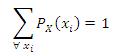
Where, i represent all the possible values that x can take and Pi is the probability of random variable X taking the value xi .
From properties 2 and 3it can be said that 0 ⇐ P(x) ⇐ 1.