Radioactive Decay
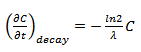
The radioactive materials that are present/injected into a groundwater aquifer will undergo radioactive decay. As a result of radioactive decay, the concentration of the material will reduce both in dissolve and sorbed phase. Moreover, the radioactive materials those have cations are also subjected to retardation on soil surface. The radioactive decay can be modeled as,
 |
(39.1) |
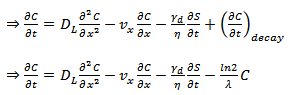
Where,  represents the radioactive half time and λ is the radioactive decay constant. Thus the one dimensional advection diffusion equation with sorption and radioactive decay process can be written as ,
 |
(39.2)
(39.3) |
Retardation due to inactivation process
The movement of virus or spreading of virus can also be modeled by the advection diffusion equation. However, in case of virus transport in aquifer, the retardation also takes place by the process of inactivation along with the sorption phenomenon. Inactivation is a chemical process by which the viruses become inactive or unable to infect. The inactivation process can be approximated by a first order approximation as given below.
 |
(39.4) |
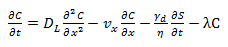
Where, λ is the inactivation coefficient. It is time a dependent coefficient. However for modeling purpose sometime it is also considered as constant. Thus for the case of virus transport in porous medium, the one dimensional advection diffusion equation can be written as,
 |
(39.5) |
Solution of advection-diffusion equation with sorption process
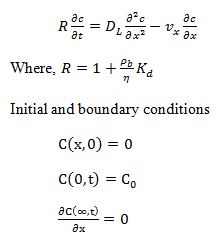
The one dimensional advection diffusion equation with sorption can be solved using the Matlab pdepe function. Initially, we will solve the advection diffusion equation with linear sorption isotherm. The governing equation can be written as,
 |
(39.6)
(39.7) (39.8) (39.9) |
For applying MATLAB pdepe function solver, the governing partial differential equation has to be written in the following form.
 |
(39.10) |