Artificial recharge is a process by which the groundwater reservoir is augmented artificially. The rapid urbanization and deforestation have considerably reduced the groundwater recharge in many parts of the world. The reduction in groundwater recharge and over exploitation of groundwater due to increasing demands, the groundwater table has been depleted in many parts of the world. For example, the groundwater table in some parts of Delhi has been depleted by 20 to 30 meters in a span of 60 years. Same is the condition in other major cities in India and other parts of the world. As such there is a need to increase the groundwater recharge by some artificial means. In this lecture, we will discuss some of the methods use for artificial recharge and also the methods use in estimation of groundwater recharge.
Techniques of groundwater recharge
The artificial techniques use for groundwater recharge can be divided in two groups, i.e. direct method and indirect method. Further, the direct method can be sub grouped as surface method and sub-surface method. The main objective of the surface method is to enhance groundwater infiltration by providing more residence time with the help of structural and nonstructural measures. Some of the structural measures are contour bunding, percolation tank, check dams, etc . On the other hand, afforestation falls under the category of nonstructural measures. The induced recharge method and aquifer modification method falls under the category of indirect method.
Direct Methods
Surface method
- 1. Percolation tank
In this method, series of earthen dams are constructed on suitable sites for storing of adequate quantity of surface water. The tank area should be selected in such a way that significant amount of water infiltrates through the bed of the tank and reaches the groundwater table. This method is very effective in alluvial area as well as in areas with hard rock. This method is very useful in providing continuous recharge after the monsoon.
2. Flooding This method is suitable for relatively flat region where water can be spread as a thin layer. Water is distributed over the region using a distribution system. This method can achieve higher rate of infiltration in a region having thin vegetation cover or sand soil cover. Fig. 29.1 shows a schematic diagram of recharge basin. |
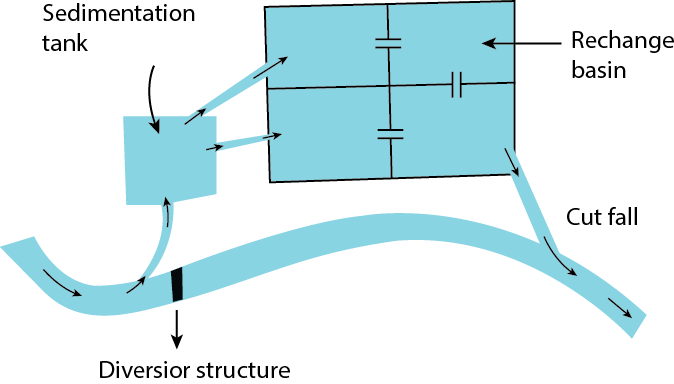 Fig. 29.1 |