The apparatus for thermal probe method shall consist of the following:
- Thermal needle probe: A device that creates a linear source and incorporates a temperature measurement element (thermocouple or thermostat) to measure variation of temperature at a point along the line.
- Constant current source: A device to produce a constant current.
- Thermal read out unit: A device to produce a digital read out of temperature in 0C.
- Voltage-Ohm-Meter (VOM) - A device to read voltage and current to the nearest 0.01 V and ampere.
- Stopwatch measuring time to the nearest 0.1 s for a minimum of 15 min.
- Equipment capable of drilling a straight vertical hole having a diameter as close as possible to that of the probe and to depth at least equal to the length of the probe.
This method can be utilized on both undisturbed and remolded sample. For undisturbed sample, thermal probe shall be pushed into the pre-drilled hole on dense specimens or directly inserted into soft ones. The length of the soil sample should be large enough to accommodate the probe length. During the measurement, a steady current is applied while the temperature is recorded as a function of time. Temperature is then plotted as a function of time on semi-log graph. A straight line is drawn through points that exhibit linear trend (pseudo steady state portion). K can be expressed in terms of the slope of this line:
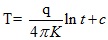 (Jackson and Taylor, 1965) (Jackson and Taylor, 1965) |
5.9 |
slope= 
Where q=heat flow rate (q= i2.r'), t is the time, T is the temperature, K is the thermal conductivity of soil, I is the current applied, r' is the resistance per unit length of probe.
Point-source method
This method eliminate the disadvantages of thermal probe due to large-sized samples in which controlling water content becomes difficult, thermal resistance produced between the soil sample and the probe inserted and movement of water occurring due to high temperature. This method is comprised of recording the voltage variations of the thermistor and variable resistor in the measuring circuit over
a period of time. The variations in temperature and heat production with time for the thermistor are calculated from the measured voltage values. Then, the thermal diffusivity of sample is determined by inverse analysis based on the Eqs. 5.6 and 5.10 (Chu 2009).
|
5.10 |

Where, K is thermal conductivity, D is thermal diffusivity, c is specific heat, T is temperature and γ is density of soil.