Guarded hot plate method
The most important steady state method for measuring the
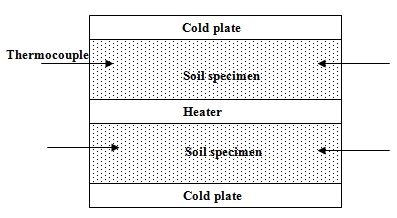
ρ of soils is the guarded hot plate (GHP) test as depicted in Fig. 5.3 (ASTM C 177). As shown in figure, two identical specimens are placed above and below a flat-plate main heater unit which is surrounded by an outer guard heater. The guard eliminates horizontal heat losses and causes heat from the main heater to flow vertically up or down through the test specimen. Liquid-cooled heat sinks are placed adjacent to the outer surfaces of the specimens. A certain temperature drop is obtained across each specimen of certain thickness.
ρ (=1/K) of the specimen material is calculated from Eq. 5.5.
|
5.5 |

Where, Q is the heat flow through soil, A is the area of soil specimen, L is the length of heat flow, and ΔT is the temperature drop. The GHP test is time consuming and only suitable for laboratory use.
|
| Fig. 5.3 Schematic diagram of the guarded hotplate method for determining thermal conductivity (ASTM C 177) |
Heat flux meter
The ρ of soil can be determined by measuring temperatures at two points and the heat flows between these points with the help of a heat flux meter. The heat flux meter is a thin plate of suitable material with known
ρ, and installed with thermal couples on both side. The temperature difference (gradient) between both sides multiplied by the
ρ of the plate gives the heat flux per unit area across the plate. This method is described in detail in ASTM C 518. The heat flux meter also requires long measuring time. The contact between the plate and the specimen need to be perfect to eliminate the influence of contact thermal resistance. Therefore, a contact pressure needs to be applied, which may alter the soil state (density or volumetric water content).
5.3.2.2 Transient state method
In transient method, temperature of the soil varies with time. Such methods are less time intensive and can be easily performed than the steady state methods. Thermal probe and point-source method
based on transient state are discussed below.
Thermal probe method
The thermal probe or needle is a rapid and convenient method for measuring ρ of soils in situ or in the laboratory. The theory of the probe method is based on the theory of the line heat source placed in a semi-infinite, homogeneous and isotropic medium. This method is described in detail in ASTM D 5334. The heat flowing from a line heat source through a medium of thermal diffusivity must conform to the following equation:
|
5.6 |

T is the temperature at time t in x direction. For cylindrical coordinates Eq. 5.6 becomes:
|
5.7 |
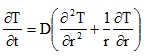
Where, r is the radial distance from the line source. Assuming heat is produced from t=0 at a constant rate q per unit length of probe, the solution of Eq. 5.7 is given by Eq. 5.8.
|
5.8 |
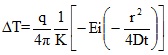
Where, Ei (-x) is an exponential integral and K or (1/ρ) is thermal conductivity.