Debt to worth ratio
This ratio is calculated by dividing total liabilities of a company by its net worth or owners' equity. It is also referred as debt to equity ratio and is given by;
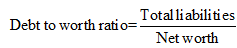
This ratio is a measure of a company's leverage and the desired value of this ratio should be less than or equal to 2.0:1. A debt to worth ratio less than 1.0:1 indicates that the firm is not utilizing the debt in the business to increase the return on the investment. Further a lower value of this ratio indicates that there is more protection to the creditors as the owners of the firm are contributing majority of the funds to the business of the firm. A debt to worth ratio of greater than 2.0:1 may result in a greater risk for the repayment of debt along with interest during recession in the construction industry.
Return on assets ratio
The return on assets ratio is calculated by dividing the net profit after taxes by the total assets of the company. This ratio is expressed as a percentage and is given by:

The net profit after tax from income statement and total assets from balance sheet of a company are used to calculate this ratio. Return on assets ratio measures how efficiently a company uses its assets to earn the return and indicates profitability of a company. For a company, the efficient use of assets earns a higher return (higher value of this ratio) whereas there is low return on assets (lower value of this ratio) for a poorly run company.
Return on sales ratio
This ratio is calculated by dividing the net profit after taxes by the net sales revenue. Return on sales ratio is expressed as a percentage. It is given by:

The operating revenues (net sales revenue) and net profit after tax from income statement are used to calculate this ratio. This ratio indicates the profit margin for a company and measures how efficiently a company can meet the adverse market conditions such as decline in demand, falling prices and increased costs. An increasing value of this ratio (%) indicates higher profit margin due to increased revenue and lowered company expenses. Similarly a lower value of this ratio (%) indicates lower profit margin due to decline in revenue and increase in the costs.