Financial ratios
Financial ratios are used to evaluate the financial status of a company. These ratios provide information about the company's ability to meet the financial obligations (i.e. ability to pay the bills, debt payment ability), profitability, liquidity and effective use of its assets. Financial ratios represent the relationship between the financial data shown on the financial statements (i.e. balance sheet and income statement). These ratios are calculated by dividing a category of financial data by another category shown on financial statements and are then compared with other companies within the industry. Through financial ratios, it is easy to identify the changes in the financial status of the company which are not evident, by only referring to the values of different categories of assets, liabilities net worth, revenue and expenses shown on the financial statements. The different financial ratios which are used to assess the financial status of a company are presented below.
Current ratio
Current ratio indicates the ability of a company to meet the short-term financial obligations. In other words it is a measurement company's ability to pay the current liabilities by using the current assets and is given by;
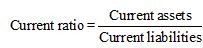
Current assets and current liabilities shown on balance sheet are used to calculate this ratio and the details about the current assets and current liabilities are already stated in Lecture 3 (Balance sheet) of this module. This ratio gives information about working capital status of a company. A current ratio of less than 1.0 to 1 (i.e. 1.0:1) indicates that the current assets of the company is not sufficient to pay its current liabilities whereas a greater value of current ratio is a strong indicator of the ability of the company to pay its current liabilities. However on the other hand a considerably higher value of current ratio indicates that much of the assets of the company might have tied up in the current assets and can be invested in other business to increase the earnings of the firm.
Quick ratio (or acid-test ratio)
Quick ratio measures the ability of a firm to pay current liabilities using cash or other assets that can be readily converted into cash. Quick ratio is also referred as acid-test ratio. It is a measure of short-term liquidity of a firm and provides information about its immediate financial status. This ratio is calculated by dividing quick assets (categories of current asset) of a firm by its current liabilities. The quick assets include cash and accounts receivable. Quick ratio is given by the following relationship.

Inventories and retentions receivable (of accounts receivable) are excluded from quick assets because these assets can not be converted into cash quickly. A quick ratio equal to or greater than 1.0:1 indicates the ability of a firm to pay the current liabilities with the quick assets. A quick ratio of less than 1.0:1 requires that the firm needs to convert inventories and other assets into cash for payment of current liabilities.