The capacity of rotary is determined by the capacity of each weaving section.
Transportation road research lab (TRL) proposed the following empirical formula
to find the capacity of the weaving section.
(1)
where is the average entry and exit width, i.e,
,
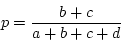
is the weaving width, is the length of weaving, and is the proportion
of weaving traffic to the non-weaving traffic.
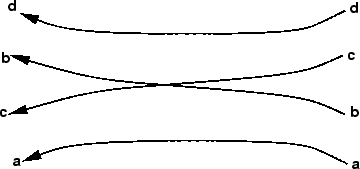
Figure 1 shows four types of movements at a weaving section, and
are the non-weaving traffic and and are the weaving traffic.
Figure 1:
Weaving operation in a rotary
Therefore,
(2)
This capacity formula is valid only if the following conditions are satisfied.
Weaving width at the rotary is in between 6 and 18 metres.
The ratio of average width of the carriage way at entry and exit to the
weaving width is in the range of 0.4 to 1.
The ratio of weaving width to weaving length of the roundabout is in
between 0.12 and 0.4.
The proportion of weaving traffic to non-weaving traffic in the rotary is
in the range of 0.4 and 1.
The weaving length available at the intersection is in between 18 and
90 m.


![\begin{displaymath}
Q_w = \frac{280 w [1+\frac{e}{w}][1-\frac{p}{3}]}{1+\frac{w}{l}}
\end{displaymath}](img1.gif)
 is the average entry and exit width, i.e,
 ,
,  is the weaving width,
  is the length of weaving, and
  is the proportion
of weaving traffic to the non-weaving traffic.
Figure
is the proportion
of weaving traffic to the non-weaving traffic.
Figure  and
and
 are the non-weaving traffic and
  and
and  are the weaving traffic.