|
Critical locations in pavement
A and B are the critical locations for tensile strains  . Maximum
value of the strain is adopted for design.
C is the critical location for the vertical subgrade strain . Maximum
value of the strain is adopted for design.
C is the critical location for the vertical subgrade strain  since the maximum value of the occurs mostly at C.
Fatigue Criteria:
Bituminous surfacings of pavements display flexural fatigue cracking if the
tensile strain at the bottom of the bituminous layer is beyond certain limit.
The relation between the fatigue life of the pavement and the tensile strain in
the bottom of the bituminous layer was obtained as
 |
(1) |
in which,  is the allowable number of load repetitions to control fatigue
cracking and is the allowable number of load repetitions to control fatigue
cracking and  is the Elastic modulus of bituminous layer.
The use of equation 1 would result in fatigue cracking of 20% of the
total area. is the Elastic modulus of bituminous layer.
The use of equation 1 would result in fatigue cracking of 20% of the
total area.
Rutting Criteria
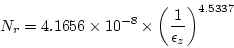
The allowable number of load repetitions to control permanent deformation can
be expressed as
 |
(2) |
 is the number of cumulative standard axles to produce rutting of 20 mm. is the number of cumulative standard axles to produce rutting of 20 mm.
|

