|
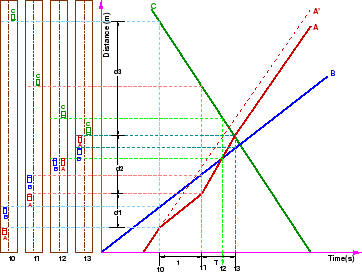
Figure 1:
Time-space diagram: Illustration of overtaking sight distance
 |
The overtaking sight distance is the minimum distance open to the vision of the
driver of a vehicle intending to overtake the slow vehicle ahead safely against
the traffic in the opposite direction.
The overtaking sight distance or passing sight distance is measured along the
center line of the road over which a driver with his eye level 1.2 m above the
road surface can see the top of an object 1.2 m above the road surface.
The factors that affect the OSD are:
- Velocities of the overtaking vehicle, overtaken vehicle and of the
vehicle coming in the opposite direction.
- Spacing between vehicles, which in-turn depends on the speed
- Skill and reaction time of the driver
- Rate of acceleration of overtaking vehicle
- Gradient of the road
The dynamics of the overtaking operation is given in the figure which is a
time-space diagram.
The x-axis denotes the time and y-axis shows the distance traveled by the
vehicles.
The trajectory of the slow moving vehicle (B) is shown as a straight line which
indicates that it is traveling at a constant speed.
A fast moving vehicle (A) is traveling behind the vehicle B.
The trajectory of the vehicle is shown initially with a steeper slope.
The dotted line indicates the path of the vehicle A if B was absent.
The vehicle A slows down to follow the vehicle B as shown in the figure with
same slope from  to to  .
Then it overtakes the vehicle B and occupies the left lane at time .
Then it overtakes the vehicle B and occupies the left lane at time  .
The time duration .
The time duration  is the actual duration of the overtaking
operation.
The snapshots of the road at time is the actual duration of the overtaking
operation.
The snapshots of the road at time  , and are shown on the left
side of the figure.
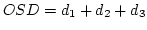
From the Figure 1, the overtaking sight
distance consists of three parts. , and are shown on the left
side of the figure.
From the Figure 1, the overtaking sight
distance consists of three parts.
 the distance traveled by overtaking vehicle A during the reaction
time the distance traveled by overtaking vehicle A during the reaction
time 
 the distance traveled by the vehicle during the actual overtaking
operation the distance traveled by the vehicle during the actual overtaking
operation 
 is the distance traveled by on-coming vehicle C during the
overtaking operation ( is the distance traveled by on-coming vehicle C during the
overtaking operation ( ). ).
Therefore:
 |
|
|
(1) |
It is assumed that the vehicle A is forced to reduce its speed to  , the
speed of the slow moving vehicle B and travels behind it during the reaction
time , the
speed of the slow moving vehicle B and travels behind it during the reaction
time  of the driver.
So is given by: of the driver.
So is given by:
 |
|
|
(2) |
Then the vehicle A starts to accelerate, shifts the lane, overtake and shift
back to the original lane.
The vehicle A maintains the spacing  before and after overtaking.
The spacing in before and after overtaking.
The spacing in  is given by: is given by:
 |
|
|
(3) |
Let be the duration of actual overtaking.
The distance traveled by B during the overtaking operation is  .
Also, during this time, vehicle A accelerated from initial velocity and
overtaking is completed while reaching final velocity .
Also, during this time, vehicle A accelerated from initial velocity and
overtaking is completed while reaching final velocity  .
Hence the distance traveled is given by: .
Hence the distance traveled is given by:
The distance traveled by the vehicle C moving at design speed  during overtaking operation is given by:
 |
|
|
(5) |
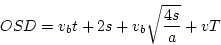
The the overtaking sight distance is (Figure 1)
 |
(6) |
where is the velocity of the slow moving vehicle in  , the
reaction time of the driver in , the
reaction time of the driver in  , is the spacing between the two
vehicle in given by equation 3 and , is the spacing between the two
vehicle in given by equation 3 and  is the overtaking
vehicles acceleration in .
In case the speed of the overtaken vehicle is not given, it can be assumed that
it moves 16 kmph slower the the design speed. is the overtaking
vehicles acceleration in .
In case the speed of the overtaken vehicle is not given, it can be assumed that
it moves 16 kmph slower the the design speed.
|


