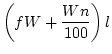
|
Stopping sight distance (SSD) is the minimum sight distance available on a
highway at any spot having sufficient length to enable the driver to stop a
vehicle traveling at design speed, safely without collision with any other
obstruction.
There is a term called safe stopping distance and is one of the
important measures in traffic engineering.
It is the distance a vehicle travels from the point at which a situation is
first perceived to the time the deceleration is complete.
Drivers must have adequate time if they are to suddenly respond to a situation.
Thus in highway design, sight distance atleast equal to the safe stopping
distance should be provided.
The stopping sight distance is the sum of lag distance and the braking
distance.
Lag distance is the distance the vehicle traveled during the reaction time  and is given by
  , where , where  is the velocity in is the velocity in  .
Braking distance is the distance traveled by the vehicle during braking
operation.
For a level road this is obtained by equating the work done in stopping the
vehicle and the kinetic energy of the vehicle.
If .
Braking distance is the distance traveled by the vehicle during braking
operation.
For a level road this is obtained by equating the work done in stopping the
vehicle and the kinetic energy of the vehicle.
If  is the maximum frictional force developed and the braking distance is is the maximum frictional force developed and the braking distance is
 , then work done against friction in stopping the vehicle is , then work done against friction in stopping the vehicle is  where where
 is the total weight of the vehicle.
The kinetic energy at the design speed is is the total weight of the vehicle.
The kinetic energy at the design speed is
Therefore, the SSD = lag distance + braking distance and given by:
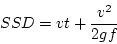 |
(1) |
where v is the design speed in , is the reaction time in  , ,
 is the acceleration due to gravity and is the acceleration due to gravity and  is the coefficient of friction.
The coefficient of friction is given below for various design speed. is the coefficient of friction.
The coefficient of friction is given below for various design speed.
Table 1:
Coefficient of longitudinal friction
| Speed, kmph |
 30 30 |
40 |
50 |
60 |
 80 80 |
|
0.40 |
0.38 |
0.37 |
0.36 |
0.35 |
When there is an ascending gradient of say  %, the component of gravity
adds to braking action and hence braking distance is decreased.
The component of gravity acting parallel to the surface which adds to the the
braking force is equal to %, the component of gravity
adds to braking action and hence braking distance is decreased.
The component of gravity acting parallel to the surface which adds to the the
braking force is equal to
 .
Equating kinetic energy and work done: .
Equating kinetic energy and work done:
Similarly the braking distance can be derived for a descending gradient.
Therefore the general equation is given by Equation 2.
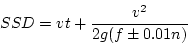 |
(2) |
|