Module 3 : Cables
Lecture 3 : Application of the General Cable Theorem for Distributed Loading
   
 
We can also use Equation 3.8 to define a general shape of the cable in terms of the mid-span dip, . Thus, the dip y at a (horizontal) distance x from the left support now is:
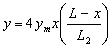
                                                                                                                                                                          (3.9)
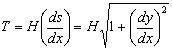
  Let T be the axial tension in the cable at a distance x . This axial tension acts along the tangent of the cable geometry. Let us measure the length of the cable by s , which is measured along the cable curve. Therefore
                                                                                                                                                     (3.10)
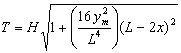
  dy / dx is the slope of the cable and it can be obtained from Equation 3.9 which defines the shape of the cable. Substituting in Equation 3.10, we get:
                                                                                                                                                  (3.11)
  This equation also shows that the maximum tension occurs at the end supports, that is at x = 0 and x = L , which is also where the slope of the cable is maximum. The minimum tension occurs at the mid-span and is equal to H .
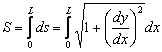
  The shape, as defined in Equation in 3.9, can be used obtain the total length of the cable ( S ) as well.
                         
                                                                                            (3.12)
 

The expression simplifies if the dip becomes very small compared to the span, that is,

                                                                                                                                                                             (3.13)
 

One should remember that Equations 3.8 to 3.12 are valid for only cables with both end supports at the same horizontal level.

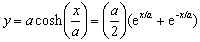
The shape of a flexible cable supported at two ends and hanging only under its self-weight is known as a catenary . It is the shape that a cable attains under uniformly distributed vertical load (self-weight, in this case). Therefore, the shape of the cable should be a parabola as per Equation 3.9 and this was what Galileo claimed. However, Leibniz and other scientists later found the proper equation for a catenary to be different from a parabola. This is because the self-weight of the cable is uniform along its curved length and not along its span. The distributed loading w that we have considered for obtaining Equation 3.9 is uniform along the span ( x ) and not along its curved shape ( s ). The equation of a catenary is:

                                                                                                                                          (3.14)
 

We will use Equation 3.9 for loads uniformly distributed along span, but not for self-weight. For cases, where the externally applied load is much larger than the cable self weight, the assumption of a parabolic shape holds good.