Lecture
3 :
Application of the General Cable Theorem for Distributed Loading
3.3
Application of the General Cable Theorem for Distributed Loading
We have seen that we can apply the general cable theorem to find the cable geometry under vertical loading cases. The theorem also applies for distributed loading, since bending moment definitions for the corresponding simply-supported beam ( and ) do not change. For a cable under uniformly distributed load w , we have:
(3.7)
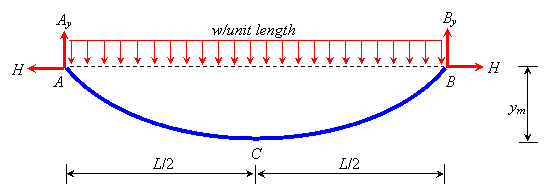
Let us consider the specific case of a cable AB under uniformly distributed loading w , with the cable's supports being at the same horizontal level (Figure 3.5). Note that the system is symmetric about its mid-span where the cable has its maximum dip. Let the span of the cable be L and its dip at the mid-span (point C ) be . We can find, from the equilibrium of vertical forces and from symmetry, that the vertical support reactions at both A and B are wL/2. Now, applying the general cable theorem (Equation 3.7) at point C , we get:
(3.8)
Figure 3.5 Free body diagram of a cable under uniformly distributed load
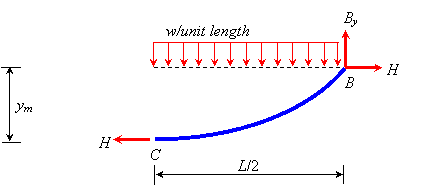
Due to symmetry, we can see that the cable tension (axial force) is horizontal at the mid-span. This can be observed also if we draw the free body diagram of either the right or the left half of the cable (Figure 3.6).
Figure 3.6 Free body diagram of the right half (CB) of the cable

 and
and  ) do not change. For a cable under uniformly distributed load w , we have:

 (3.7)
(3.7) . We can find, from the equilibrium of vertical forces and from symmetry, that the vertical support reactions at both A and B are wL/2. Now, applying the general cable theorem (Equation 3.7) at point C , we get:
  (3.8)
(3.8)