| |
These equations can also be expressed as relation between the stress and strain tensors |
| |
Note that, in a strain tensor, the shear strain (e.g.  ) is replaced by the pure or irrotational shear strain ( ) is replaced by the pure or irrotational shear strain (  ). ). |
| |
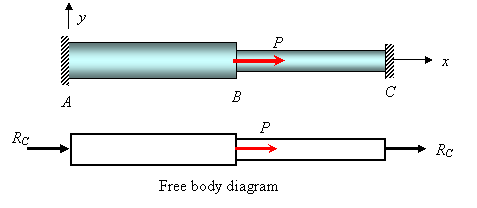
Compatibility conditions represent restriction on deformations at specific locations in a system. The location can be both inside the system and at its boundary. The deformations in a system have to be compatible with the geometry of the surrounding (both external and internal), and this compatibility is assured through these conditions. In other words, compatibility conditions specify that deformations in a member/part of a system have to be compatible with the support conditions (external), as well as with other members/parts of the system (internal). For example, in the case of bar ABC in (Figure 1.10), various compatibility conditions on horizontal displacements are: |
| |
Figure. 1.10 Axially loaded bar ABC
|
| |
Where
 is the deflection of bar AB at point B. is the deflection of bar AB at point B.
The deformation behaviour of a structural element is usually expressed through differential equations and the associated compatibility conditions are represented as boundary conditions for those equations.
|