| |
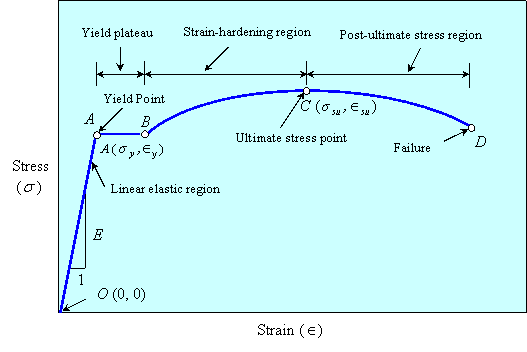
Equilibrium equations help us obtain the forces that are acting, both internally and externally, at various parts of a body. However, for deformable solid bodies, understanding their deformation behaviour under the given stress/loading condition (based on the equilibrium) is of primary importance. The deformation behaviour in such a system is studied through various parameters, such as strain, displacement, rotation, etc. These deformation parameters are obtained based on the stress-strain relations of the material which the deformable solid is made of. These are known as Constitutive Relations and are material-specific. The stress-strain diagram for ductile steel (Figure 1.9) based on a tension test is an example of constitutive relations. It gives us a relation between the engineering (tensile) stress (  ) and engineering (tensile) strain ( ) and engineering (tensile) strain (  ) for ductile steel at different stress (or strain) values. ) for ductile steel at different stress (or strain) values.
|
| |
Figure 1.9 Stress-strain diagram for ductile steel
|
| |
Similar stress-strain diagram can be obtained (through experiments) for different materials (aluminium, wood, tool steel, concrete, etc.) and for different types of deformation (uniaxial tensile and compressive, shear, transverse, dilatational, etc.). For the ease of use, these relations are idealized into simple mathematical rules. In Structural Mechanics, we will limit ourselves to linear elastic isotropic homogeneous materials only.
A material is called linear elastic if its stress-strain relation is linear and if when the material is unloaded it traces back the same stress-strain (loading) path. In other words, stress is a single-valued linear function of strain. The behaviour of ductile steel from point “O” to “A” (Figure 1.9) is a linear elastic one. A material will be isotropic if its constitutive relations are non-directional (same for any direction in space, x , y or z ) and it will be homogeneous if it displays the same properties (e.g. a constitutive relation) at any point of the system (same properties at [  ] and [ ] and [  ]). Some basic constitutive relations for a linear elastic isotropic homogeneous material are briefly discussed in the following sections. ]). Some basic constitutive relations for a linear elastic isotropic homogeneous material are briefly discussed in the following sections. |