In “resistivity sounding” or “depth profiling” the center point of the set up is stationary whereas the spacing of the electrode is varied, as shown in fig.1.14. A detailed evaluation of the results of the resistivity sounding is rather complicated, but preliminary indications of the subsurface conditions may be obtained by plotting the apparent resistivity as a function of the electrode spacing. When the electrode spacing reaches a value equal to the depth to a deposit with a resistivity materially different from that of overlying strata, the resultant diagram will generally show a more or less pronounced break or change in curvature as shown in fig. 1.15. As the slope of the line varies at  , this indicates that there is change in the strata beyond depth , this indicates that there is change in the strata beyond depth  . .
In practice, many several different arrays are used. For simple sounding, a Wenner array is used as shown in fig. 1.16. Then, the resistivity is given as,
|


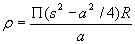 (Refer fig. 1.17)
