| |
| | |
|
This service provides information to the travellers with a suggested route to
reach a specified destination, along with simple instructions on upcoming turns
and other manoeuvres.
This also provides travellers of all modes the real-time information about the
transportation system, including traffic conditions, road closures, and the
status and schedule of transit systems.
The benefits of this service are reduced delay and drivers stress levels
particularly in an unfamiliar area.
This user service provide real-time ride matching information to travellers in
their homes, offices or other locations, and assists transportation providers
with vehicle assignments and scheduling.
Travellers give information to the service center and get number of ride sharing
options from which they can choose the best.
This service provides a business directory of information on travel-related
services and facilities like the location, operating hours, and availability of
food, lodging, parking, auto repair, hospitals, gas stations and police
facilities.
This also makes reservations for many of these traveler services.
The traveler services information are accessible in the home, office or other
public locations to help plan trips.
These services are available en-route also.
This service collects the real time data from the transportation system,
processes it into usable information, and uses it to determine the optimum
assignment of right-of-way to vehicles and pedestrians.
This helps in improving the flow of traffic by giving preference to transit and
other high occupancy vehicles or by adjusting the signal timing to current
traffic conditions.
The information collected by the Traffic Control service is also disseminated
for use by many other user services.
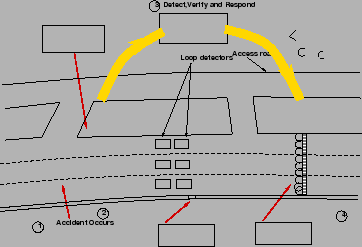
Figure 1:
Incident management
 |
This service aims to improve the incident management and response capabilities
of transportation and public safety officials, the towing and recovery industry,
and others involved in incident response.
Advanced sensors (close circuit TV cameras), data processors and communication
technologies are used to identify incidents quickly and accurately and to
implement response which minimizes traffic congestion and the effects of these
incidents on the environment and the movement of people and goods.
Fig. 1 shows the occurrence of incident and its
detection by the center and decision implemented responding to the incident on a
highway pertaining to incident management.
This user service develop and implement strategies to reduce the number of
single occupancy vehicles while encouraging the use of high occupancy vehicles
and the use of more efficient travel mode.
The strategies adopted are:
- Congestion pricing
- Parking management and control
- Mode change support
- Telecommuting and alternate work schedule.
The main objective of this service is to monitor and implement strategies to
divert traffic away from sensitive air quality areas, or control access to such
areas using advanced sensors.
This also used to identify vehicles emitting pollutants exceeding the standard
values and to inform drivers to enable them to take corrective action.
This helps in facilitating implementation and evaluation of various pollution
control strategies by authorities.
This service is to provide improved control of highway and train traffic to
avoid or decrease the severity of collisions between trains and vehicles at
highway-rail intersections.
This also monitors the condition of various HRI equipments.
This group of service is concerned with improving the public transportation
systems and encouraging their use.
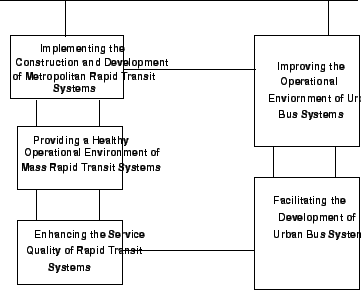
Fig. 2 shows different public
transportation facilities. This group is divided in four services which are
described as below:
Figure 2:
Different public transportation systems
 |
This user service collects data through advanced communications and information
systems to improve the operations of vehicles and facilities and to automate the
planning and management functions of public transit systems.
This offers three tasks:
- To provide real-time computer analysis of vehicles and facilities to
improve transit operations and maintenance by monitoring the location of transit
vehicles, by identifying deviations from the schedule, and offering potential
solutions to dispatchers and operators.
- To maintain transportation schedules and to assure transfer connections
from vehicle to vehicle and between modes to facilitate quick response to
service delays .
- To enhance security of transit personnel by providing access management of
transit vehicles.
This service is intended to provide information on expected arrival times of t
vehicles, transfers, and connections to travellers after they begin their trips
using public transportation.
This also provide real-time, accurate transit service information on-board the
vehicle, at transit stations and bus stops to assist travellers in making
decisions and modify their trips underway.
The aim of this service is to offer public transport facility to travellers by
assigning or scheduling vehicles by
- diverting flexibly routed transit vehicles.
- assigning privately operated vehicles on demand which include small buses,
taxicabs, or other small, shared-ride vehicles.
Under this service, travellers provide information of their trip origin and
destination to service station.
The center then assigns the closest vehicle to service the request and to inform
the travellers regarding arrival of such vehicles well in advance to reduce
their anxiety.
This user service creates a secure environment for public transportation
operators and support staff and monitors the environment in transit
facilities, transit stations, parking lots, bus stops and on-board transit
vehicles and generates alarms (either automatically or manually) when necessary.
It also provides security to the systems that monitor key infrastructure of
transit (rail track, bridges, tunnels, bus guide ways, etc.).
|
|
| | |
|
|
|


