| |
| | |
|
In many urban centers, some areas are exclusively allotted for parking which
will be at some distance away from the main stream of traffic.
Such a parking is referred to as off-street parking.
They may be operated by either public agencies or private firms.
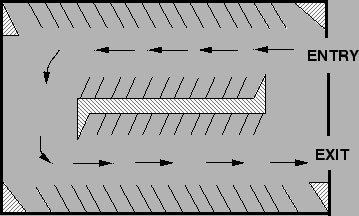
A typical layout of an off-street parking is shown in figure 1.
Figure 1:
Illustration of off-street parking
 |
There are some minimum parking requirements for different types of building.
For residential plot area less than 300 sq.m require only community parking
space.
For residential plot area from 500 to 1000 sq.m, minimum one-fourth of the
open area should be reserved for parking.
Offices may require at least one space for every 70 sq.m as parking area.
One parking space is enough for 10 seats in a restaurant where as theatres and
cinema halls need to keep only 1 parking space for 20 seats.
Thus, the parking requirements are different for different land use zones.
Parking has some ill-effects like congestion, accidents, pollution, obstruction
to fire-fighting operations etc.
- Congestion: Parking takes considerable street space leading to
the lowering of the road capacity.
Hence, speed will be reduced, journey time and delay will also subsequently
increase.
The operational cost of the vehicle increases leading to great economical loss
to the community.
- Accidents: Careless maneuvering of parking and unparking leads to
accidents which are referred to as parking accidents.
Common type of parking accidents occur while driving out a car from the parking
area, careless opening of the doors of parked cars, and while bringing in the
vehicle to the parking lot for parking.
- Environmental pollution: They also cause pollution to the
environment because stopping and starting of vehicles while parking and
unparking results in noise and fumes.
They also affect the aesthetic beauty of the buildings because cars parked at
every available space creates a feeling that building rises from a plinth of
cars.
- Obstruction to fire fighting operations: Parked vehicles may
obstruct the movement of firefighting vehicles.
Sometimes they block access to hydrants and access to buildings.
|
|
| | |
|
|
|


