| |
| | |
|
The activity of specifying data to the model that describes traffic operations
and other features which are site specific is called calibration of the model.
In other words, calibration is the process of quantifying model parameters
using real-world data.
This data may take the form of scalar elements and of statistical
distributions.
Calibration is a major challenge during the implementation stage of any model.
The commonly used methods of calibration are regression, optimization, error
determination, trajectory analysis etc.
A brief description about various errors and their significance is presented in
this section.
The optimization method of calibration is also explained using the following
example problem.
The parameters obtained in GM car-following model simulation are given in Table
below.
Field observed values of acceleration of follower is also given. Calibrate the
model by finding the value of  .
Assume l=1 and m=0.
Use optimization method to solve the problem. .
Assume l=1 and m=0.
Use optimization method to solve the problem.
Table 1:
Parameters of GM Model
Observed Acceleration ( ) ) |
Velocity difference, dv |
Distance
headway, dx |
| 0.23 |
1.5 |
29.13 |
| 0.46 |
1.88 |
29.97 |
| 0.67 |
1.16 |
30.73 |
| 0.82 |
0.32 |
31.10 |
|
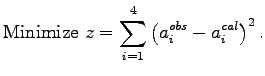
Step 1: Formulate the objective function (z).
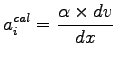
Step 2: Express  in terms of .
As per GM model (since l=1 and m=0), in terms of .
As per GM model (since l=1 and m=0),
Step 3: Therefore the objective function can be expressed as:
Step 4: Since the above function is convex, differentiating and then equating to zero
will give the solution (as stationary point is the global minimum).
Differentiating with respect to and equating to zero,
Then, value of is obtained as 9.74.
|
|
| | |
|
|
|