| |
| | |
|
The blockage length and the average delay for the lane change are calculated
based on the following formulae.
where, T = Total time of headways rejected, BL = blockage length, Vs = stream
velocity, Vr = relative velocity, N = number of acceptable gap
In a two lane, one way stream of 1000 vph with 360 vehicles in Lane A and the
remaining vehicles in lane B.
8% of the vehicles in lane A have gaps less than 1 sec and 18% of the
vehicles in lane A have gaps less than 2 sec.
Compute the time during which vehicles in Lane B may not change to Lane A in 1
hour.
Assume driver requires one second ahead and behind in making a lane change.
Total acceptable time for lane change in an hour = 3600 - total rejected
headway
- total clearance time.
Given that 0 to 1 second Gaps is 8% of 360 = 29 and 1 to 2 second Gaps is
(18-8) % of 360 = 36. Total = 65 Gaps.
Time spent in Gaps 0 to 1 second = 29 x .5 = 14.5 sec, and
Time spent in Gaps 1 to 2 second = 36 x 1.5 = 54.0 sec.
As 65 Gaps are rejected, Acceptable Gaps are (360-65) = 295 Gaps.
In this 295 Gaps clearance time = 295 x 2 = 590 sec.
Time lost in rejected gap = 14.5+54=68.5.
Therefore,
Total time left in one hour to accept Gap=(3600 - 590 - 68.5) = 2941 sec.
Vehicle can change lane in (2941/3600) = 81.7% of the Total time.
Vehicle is prevented from changing lane in 18.3% of the time.
Figure 1:
Numerical example
 |
In a two lane, one way stream of 1000 vph with 360 vehicles in Lane A and the
remaining vehicles in lane B.
8% of the vehicles in lane A have gaps less than 1 sec and 18% of the
vehicles in lane A have gaps less than 2 sec.
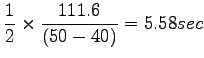
Compute the average waiting for the driver to make a lane change.
Assume driver velocity in lane B = 40 kmph and stream velocity = 50 kmph.
Solution:
The average length of headways and portions of head ways of insufficient length
for a lane change, which may be considered as general blockages moving in the
stream.
Division of this Blockage length by the relative speed determines potential
total delay time of the blockade.
Finally since a delayed vehicle is as likely to be at the head as at the tail
of such a blockade at the moment of desired lane change, the total delay must
be divided by 2 for average delay time.
where
 , ,  = 50 kmph, N = acceptable gaps.
So 0 to 2 second Gaps = 18 % of 360 = 65.
Therefore N = 360-65 = 295.
BL = = 50 kmph, N = acceptable gaps.
So 0 to 2 second Gaps = 18 % of 360 = 65.
Therefore N = 360-65 = 295.
BL =
 = 111.6. = 111.6.
Figure 2:
Numerical example
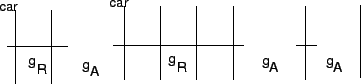 |
In the above figure the vertical lines are the center line of the cars and
 , ,  represents the acceptable and rejected gaps respectively. represents the acceptable and rejected gaps respectively.
|
|
| | |
|
|
|