14.2 Nucleic Acids
- Nucleic acids are biopolymers composed of nucleotide subunits linked by phosphodiester bonds. DNA and RNA are polynucleotides. Nucleotide triphosphate serves as substrate precursor for the biosynthesis of nucleic acids. The nucleotides are linked by the nucleophilic attack of 3’-OH of one nucleotide triphosphate on the a-phosphorus of another nucleotide (Figure 4).
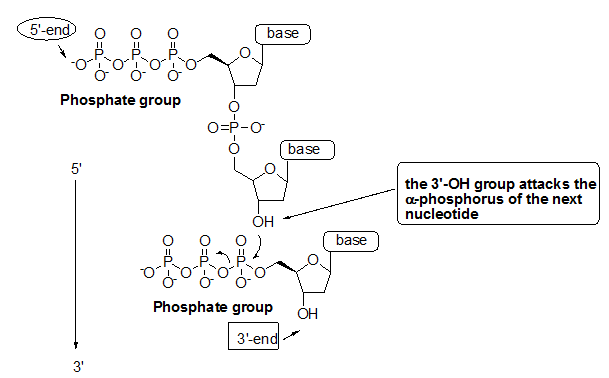
Figure 4
- Primary Structure: It describes the sequence of bases in the strand. By convention, the sequence of bases is written in the 5’ to 3’ direction.
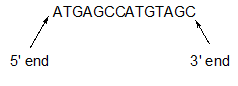
Figure 5. Competitive Inhibition
- Secondary Structure: DNA consists of two strands of nucleic acids with the sugar-phosphate backbone outside and the base inside. The chains are held together by H-bonding between the base of one strand with the base of another strand. Adenine pairs with thymine, while guanine pairs with cytosine through two and three H-bonds, respectively. This means if we know the sequences bases in one strand, we will be able to sequence the bases in the other strand (Figure 5a). If the two strands run in opposite directions, the strands are not linear. Instead they are twisted into a helix around common axis, which is known as double helix (Figure 5b).
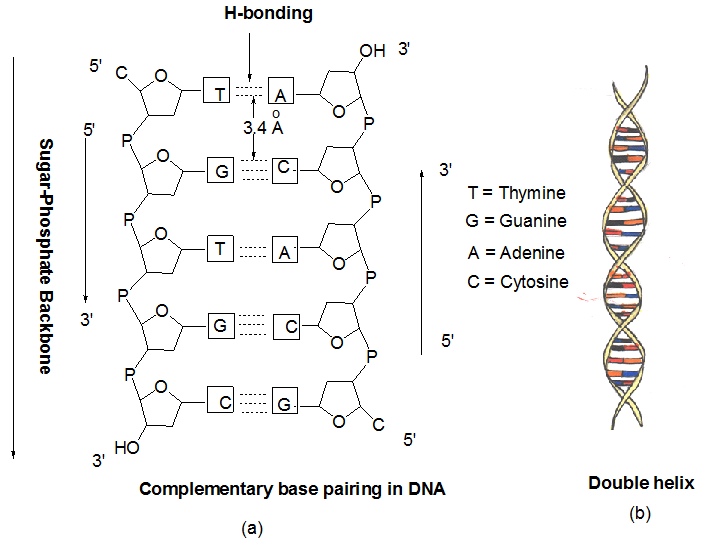
Figure 5
- Figure 6 shows the base pairing in DNA: adenine and thymine form two H-bonds; cytosine and guanine form three H-bonds
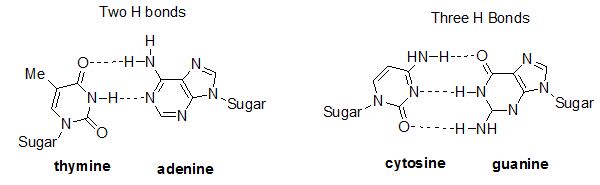
Figure 6
14.3 Stability of DNA and RNA
In RNA, the 2’-OH of ribose attacks the adjacent phosphodiester group that leads to the cleavage of the strand (Figure 7). This reaction does not take place in DNA, because it does not have the 2’-OH group. Thus, DNA remain intact throughout the life span of cells
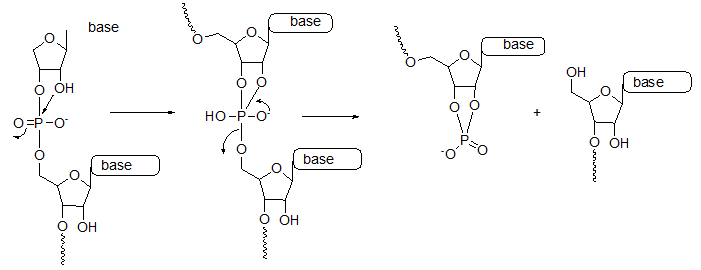
Figure 7