Nucleic acids are targets of many important drugs, including several anticancer agents. There are two types of nucleic acids: deoxyribonucleic acid (DNA) and ribonucleic acid (RNA). DNA encodes the hereditary details and controls the growth and division of the cells. The genetic information stored in DNA is then transcribed into RNA, and the details in RNA are then translated for the synthesis of the proteins.
14.1 Nucleosides and Nucleotides
- Nucleic acids are chains of five membered ring sugars linked by phosphate groups (Figure 1). The anomeric carbon of each sugar is bonded to a nitrogen of heterocyclic amine in a b-glycosidic linkage. In RNA, the five membered sugar is D-ribose. In DNA, the five membered sugar is 2’deoxy-D-ribose.
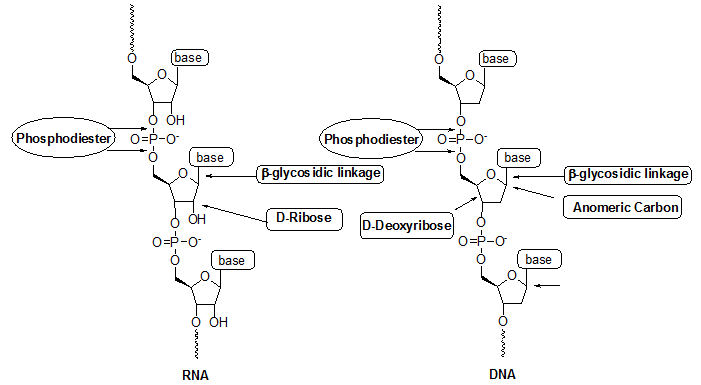
Figure 1
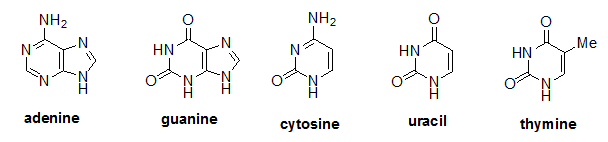
- The difference in heredity among the species is determined by the sequence of the bases in DNA. DNA has four bases: adenine, guanine, cytosine and thymine.
- RNA also contains four bases. Three-adenine, guanine and cytosine- are same as those in DNA. But the fourth base in RNA is uracil instead of thymine.
- A compound with a base bonded to D-ribose or 2’-deoxy-D-ribose is called nucleoside. Figure 2 shows an example using adenine as base. Similarly, other bases (guanine, cytosine, uracil and thymine) can also make bond to the sugar to give the corresponding nuleotides. The stereochemistry of the linkage between the base and the ribose is most commonly b.
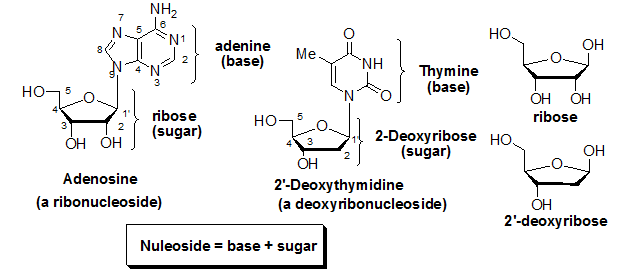
Figure 2
- Nucleotide is nucleoside with either the 5’ or the 3’-OH group bonded in an ester linkage to phosphoric acid. The nucletotide where the sugar is D-ribose is called ribonuleotide, whereas the nucleotide with 2’-deoxy-D-ribose is called deoxyribonuleotide (Figure 3).
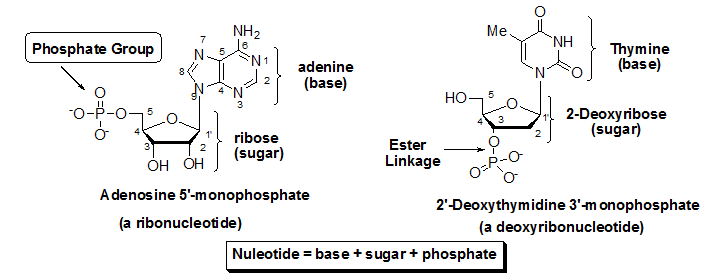
Figure 3