12.5 The Isoelectric Point (pI)
The isolectric point (pI) of an amino acid is the pH where it has no net charge. For example, the pI of an amino acid that does not possess an ionizable side chain is midway between its two pKa values (Scheme 6).
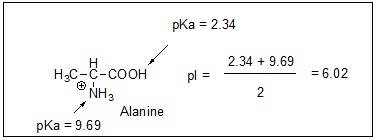
Scheme 6
In case of an amino acid that contains an ionizable side chain, the pI is the average of the pKa values of the similarly ionizing groups. For example, see pI of lysine (Scheme 7).
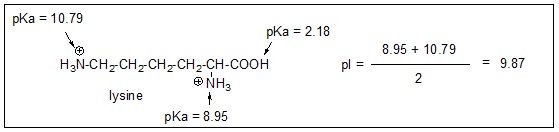
Scheme 7
12.6 Separation of Amino Acids
A. Electrophoresis
In this method, the amino acids can be separated on the basis of their pI values (Scheme 8). A few drops of a solution of amino acid mixture are applied to the middle of the piece of filter paper or to a gel. When this paper or gel is placed in a buffered solution between two electrodes and an electric field is applied, an amino acid having a pI greater than the pH of the medium will have an overall positive charge and will move toward the cathode. While an amino acid with a pI less than the pH of the buffer will have an overall negative charge and will move toward anode. In case of the molecules have the same charge, the larger one will migrate more slowly compared to that of the smaller one during the electrophoresis. After the separation, the filterpaper is sprayed with ninhydrin and dried in a warm oven to give purple colored spot. The amino acids are identified by their location on the paper comparing with a standard.