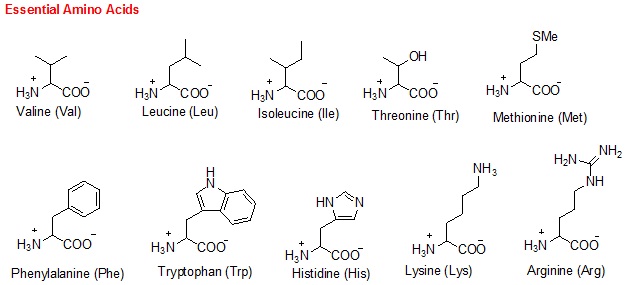
Scheme 3
12.3 Configuration α-Amino Acids
In 19 of the 20 naturally occurring α-amino acids, except glycine, the α-carbon is an asymmetric center. Thus, they can exit as enantiomers, and the most amino acids found in nature have L-configuration. Scheme 4 shows the Fischer projection of an amino acid with a carboxyl group on the top and the R group on the bottom of the vertical axis is an L-amino acid if the amino group is on the left and a D-amino acid if the amino group is one the right.
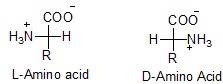
Scheme 4
12.4 Acid-Base Properties α-Amino Acids
Amino acid has a carboxyl group and amino group, and each group can exist in an acidic or basic form, depending on the pH of the solution in that the amino acid is dissolved. In addition, some amino acids, such as glutamate, also contain ionizable side chain.
The pKa values of the carboxyl group and the protonated amino group of the amino acids approximately are 2 and 9, respectively (Scheme 5). Thus, both groups will be in their acidic forms in highly acidic medium (pH ~ 0). At pH 7, the pH of the solution is greater than the pKa of the carboxyl group, but less than the pKa of the protonated amino group. Hence, the carboxyl group will be in its basic form and the amino group in its acidic form (called Zwitter ion). In strongly basic medium (pH 11), both groups will be in basic form. Thus, an amino acid can never exist as an uncharged compound, regardless of the pH of the medium.

Scheme 5