Fission and Fusion:
A generous amounts of energy can be liberated either by splitting a large nucleus in apart by the bombardment of small nucleus, the process is known as fission, or by combining small nucleus to generate a bigger nucleus, the process is called fusion.
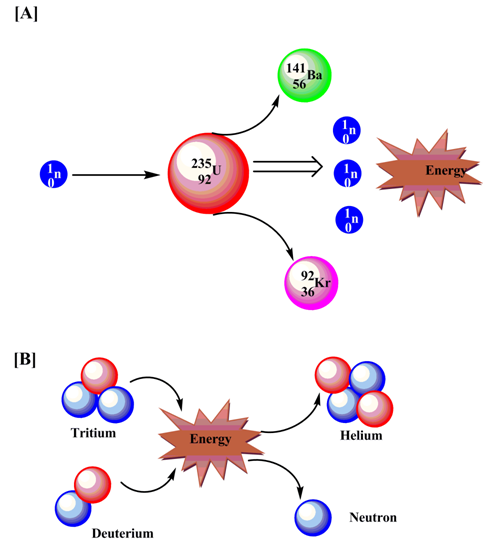
Figure 6.6. Schematic representation of a fission[ A ] and a fusion[ B ] processes.
In the fission process certain heavy elements splits into smaller elements together with generation of huge energy. For example,  splits to
  , and three neutrons when bombarded with a neutron. This type of splitting releases energy in the form of kinetic energy and radiation. The origin of the generated energy is the mass difference [E = mC 2]. The process not only produces energy but also releases additional neutrons. These neutrons can be further used to fission for the other Uranium nuclei. Hence, a chain reaction can be initiated.
In fusion processes, light nuclei are combined and provide also light and stable nuclei together with production of energy. The advantage of this process over the fission is the easy availability of the nuclei.