Examples:
When the orbital contribution is minimal and could be ignored. Hence, L = 0 and in this condition, the previous equation reduces to
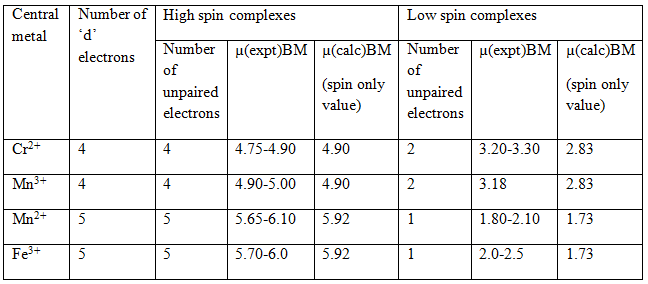
µ= [4S(S + 1)]½ = 2[S(S + 1)]½ BM
This is known as the spin-only formula for magnetic moment. By recognizing that S will be related to the number of unpaired electrons (II) by S = n/2, the expression may be further simplified to
µ = [n(n + 2)]½ BM
Problems :
(A) What will be the effective magnetic moment difference between a high - spin Fe(III) and a low - spin Fe(III) ion.? In both case consider g = 2.00.
Hints: In case of high - spin Fe(III) there are five unpaired electrons and for low - spin Fe(III) there are only a single unpaired electron.
(B) What will be the effective magnetic moment difference between a tetrahedral Cu(II) and an octahedral Cu(II) ions?
Hints: Cu(II) is a d 9 system. Therefore, in both geometrical arrangements there will be only one unpaired electron.
(C) Why does the effective magnetic moment of vanadium(IV) and Cu( II) in an octahedral geometry differ?
Hints: Spin - orbit coupling is different.