Magnetic properties:
A brief knowledge is required for understanding the electronic spectroscopy of transition metal complexes. Additional and complementary information can be provided by magnetic measurement because for the partially filled d or orbitals of transition metal, a range of magnetic properties can be expected, depending on the oxidation state, electronic configuration and coordination number of the central metal.
Classification of substance according to magnetic properties:
Diamagnetism: When any substance is placed in an external magnetic field, there is an induced circulation of electrons producing a net magnetic moment aligned in opposition to the applied field. This is the diamagnetic effect and it arises from paired electrons within a sample, since all compounds contain some paired electrons, diamagnetism is a universal property of matter. If a substance has only paired electrons, this effect will dominate, the material will be classified as diamagnetic, and it will be slightly repelled by a magnetic field.
Paramagnetism: It is produced by unpaired electrons in a sample. The spins and orbital motions of these electrons give rise to permanent molecular magnetic moments that tend to align themselves with an applied field, Because it is much larger than the diamagnetic effect, the paramagnetic effect cancels any repulsions between an applied field and paired electrons in a sample, Thus even substances having only one unpaired electron per molecule will show a net attraction into a magnetic field. The paramagnetic effect is observed only in the presence of an external field.

There are three possible modes of coupling between those components: spin-spin, orbital-orbital and spin-orbital. For some complexes, particularly those of the lanthanides, we must consider all three types of coupling. The theoretical paramagnetic moment for such a complex is given by
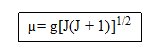
Where j is the total angular momentum quantum number and g is the Land splitting factor for the electron, defined as
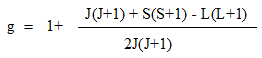
The value of J depends on the total orbital angular momentum quantum number L and the total spin angular momentum quantum number S.
Magnetic properties of some compound of lanthanides metals at room temperature (300 K).
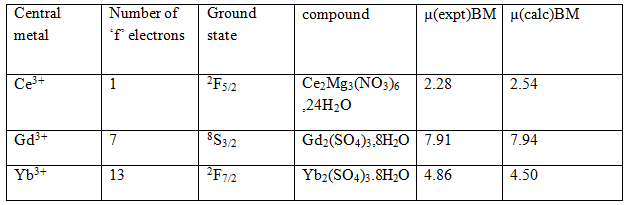
µ(calc)BM is calculated by µ= g[J(J + 1)]½ formula
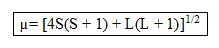
For complexes in which spin-orbit coupling is non-existent or negligible but spin and orbital contributions are both significant, the predicted expression for µ is