Valance Theory of coordination complexes and its limitations:
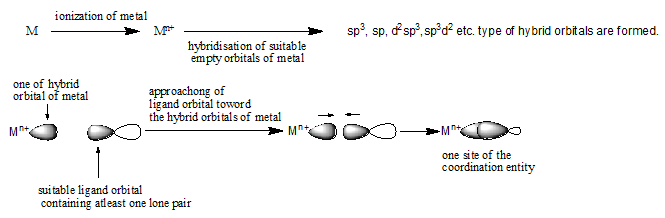
According to VBT theory, a coordination entity is formed as a result of coordinate covalent bond formation by electron pairs from ligands (Lewis bases) through overlap of appropriate atomic orbitals (usually hybrid orbitals) of the metal (Lewis acid) and ligand.
A coordination entity is composed of central atom, usually that of metal, to which is attached a surrounding array of other atoms or group of atoms, each of which is called ligand.
Hypothetical sequence of steps for the formation of a coordination entity;
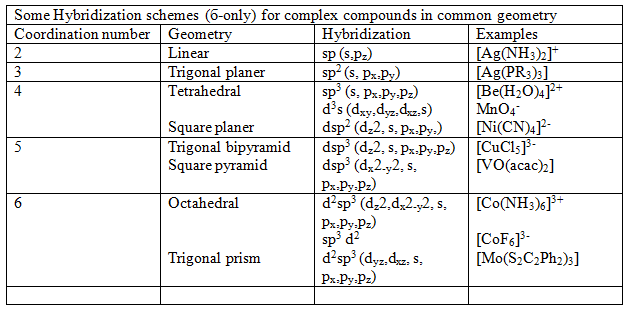
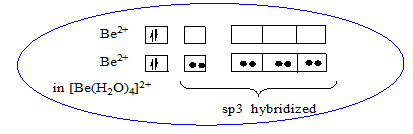
Q. what is the shape you expect for the complex [Be(H2O)4]2+ ?
Here Be2+ ion can use sp3 hybrid orbitals to receive electron pairs from four water molecules. [Be(H2O)4]2+ has tetrahedral geometry .
Limitation of the VBT:
- Fail to explain the colour & characteristics of absorption spectra of complex compounds.
- Orbital contribution and temperature dependency on magnetic moment of coordination complex are not properly explained by VBT.
- It is not helpful to predict the mystery of formation of outer or inner orbital coordination complex.
- VBT fails to predict any distortion in the shapes of the coordination complexes from regular geometry.
Crystal field theory: d-orbital splitting in various ligand fields, spectral properties and magnetism of coordination complexes:
Crystal-field theory:
In the crystal-field theory , a ligand lone pair is modelled as a point negative charge (or as the partial negative charge of an electric dipole) that repels electrons in the d orbitals of the central metal ion. The theory concentrates on the resulting splitting of the d orbitals into groups with different energies, and uses that splitting to rationalize and correlate the optical spectra, thermodynamic stability, and magnetic properties of complexes.