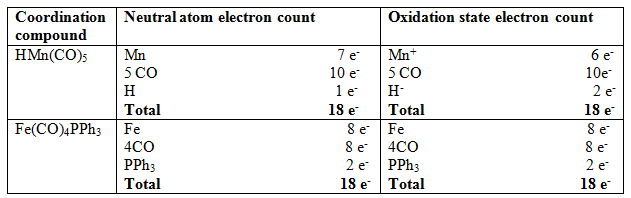
Q. Determine metal-metal bond order using 18 electron rule?
A) Mn2(CO)5 B) [( Ƞ 5 -Cp)Fe(CO)2]2 C) [Pt(CO)3]22+
Answer: A) one B) one C) three
Referance/Hints: For case of [(η5 -Cp)Fe(CO)2]2
Neutral atom electron count for each Fe –atom
One Ƞ η5 - Cp = 5
Two CO group = 4
Fe atom alone = 8
Fe-Fe bond order = x
Tatal = 17 + x
As, [(η5 - Cp)Fe(CO)]2 is an stable complex, then each Fe has valence electron on the metal is equal to 18 i.e. (17 + x) = 18.
X= 1 i.e. bond order = one
Q. [(η5 - Cp)Mn(CO)x]2 has a Mn-Mn double bond . What is the value of x?
Answer: 2
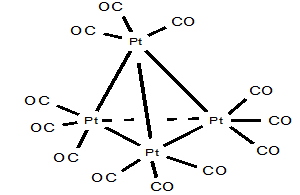
Q.[Ir4(CO)12] what would be the structure according to 18 electron rule?
Q. Count the valence electron on the metal in the following complexs:
a) MoH4(PR3)4 b) [(η5 -cp)2 Fe ] c) [(η3 - C3H5)2 Ni] d) [[(η5 -cp)2 TiCl2 ]
Answer: a)18 b)18 c) 16 d)16
Q. Even through [W(CO)3 (PCy3)2] is a 16 VE species but it is stable. Account for the stability?
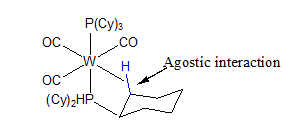
In neutral electron atom calculation [W(CO)3 (PCy3)2] is 16 VE species . But due to Agostic interaction (a C-H bonding pair of electrons coordinated to the metal centre) Metal centre attain 18 VE stable conformation.
Agostic interaction is possible due to presence of a valence co-ordination sites as well as the lack of VE on metal centre.