Coordination Chemistry:
In chemistry , a coordination complex or metal complex , is an atom or ion (usually metallic), bound to a surrounding array of molecules or anions which are known as ligands or complexing agents.
Werner's coordination theory & its experimental verification:
In 1893, Werner was the first to propose correct structures for coordination compounds containing complex ions , in which a central transition metal atom is surrounded by neutral or anionic ligands .
CoCl3•6NH3 This type of representation does not implies any proper geometry around the central metal ion


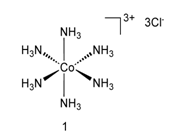
The basic postulates of Werner's theory may be summerised as follows:
- Metal possess two types of valency:
- The primary or principal valency; this is the ionisable valency
e.g. In [Co(NH3)5Cl]2+, Co has primary valency +3 and in [Ni(CO)4], Ni has primary valency 0.
Werner's primary valence corresponds to the oxidation state.
- A secondary nonionizable valency
- Every metal has a fixed number of secondary valency
Werner's secondary valence is always called coordination number.
e . g . In [Co(NH3)5Cl]2+, Co has secondary valence equal to six and in [Ni(CO)4], Ni has secondary valence equal to 4.
- Primary valences are satisfied by negative ions whereas the secondary valences are satisfied by negative ions as well as neutral molecule or cations .
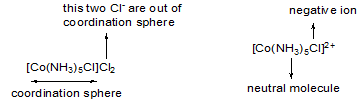
- The secondary valences are directed in space around the central metal ion in definite geometrical disposition.
Effective atomic number concept:
Effective atomic number (EAN), is the number which represents the total number of electrons surrounding the nucleus of a metal atom in a metal complex.
EAN = metal atom's electrons + the bonding electrons from the surrounding electron-donating atoms and molecules
For case of [Co(NH3)6]3+ , it is 36, (trivalent cobalt ion (24) and the number of bonding electrons from six surrounding ammonia molecules, each of which contributes an electron pair .)
The resulting effective atomic number is numerically equal to the atomic number of the noble-gas element found in the same period in which the metal is situated.
This rule seems to hold for most of the metal complexes with carbon monoxide , the metal carbonyls as well as many organometallic compounds (chemical compound having metal - carbon bond are known as organometallic compounds) .
By using this rule it is possible to predict the number of ligands in these types of compounds and also the products of their reactions. The EAN rule is often referred to as the “18-electron rule” since, if one counts only valence electrons , the total number is 18 .
18-electron rule:
Every transition metal on forming a coordination compound has a tendency to make the total number of valence electron is equal to 18. By this way the metal centre achieved pseudo noble gas configuration.