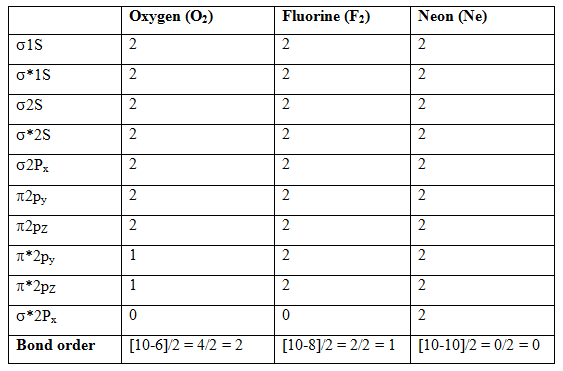
Oxygen, fluorine and neon have same MO energy distribution.
Note.
1. In O2 molecule each π*2py and π*2pz contains one unpaired electron. Therefore O2 is paramagnetic.
2. If O2 is oxidized to O2+ , the one electron is removed from a π* orbital which is anti - bonding orbital. Therefore, the bond order increases, [10-5]/2 = 5/2 = 2.5.
3. If O2 is reduced to O2− , the one electron is added to a π* orbital which is anti - bonding orbital. Therefore, the bond order decreases, [10-7]/2 = 3/2 = 1.5.
4. If N2 is oxidized to N2+ , the one electron is removed from a π orbital which is bonding orbital. Therefore, the bond order decreases, [9-4]/2 = 5/2 = 2.5.
5. If N2 is reduced to N2− , the one electron is added to a π* orbital which is anti - bonding orbital. Therefore, the bond order decreases, [10-5]/2 = 5/2 = 2.5. This fact indicates that the bond distance between two N atoms in N2+ or N2− is same.
MOs of CO:
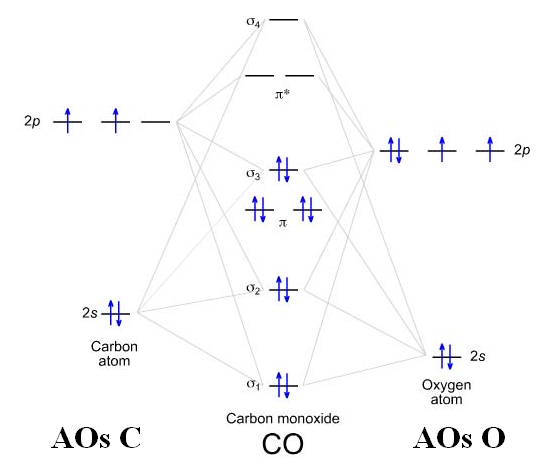
Here the energy of p and s atomic orbitals of C is higher than that of O. When the electronegativity of an atom increases, effective nuclear charge also increases and hence, energy decreases. Oxygen is more electronegative that carbon. Therefore, the energy of p and s atomic orbitals of O is lower than that of C. It is also important to note that the energy gap between the s and p orbitals increases with increase of effective nuclear charge.