Molecular Orbital Theory (MO-theory):
In the Valence bond theory, the individuality of atomic properties of the constituting atoms forming a molecule is retained too some extent. Whereas, in the molecular orbital theory it is considered that molecular orbitals are formed by the linear combination of the two constituting atomic orbitals´ wave functions.
Let us consider, ψ(A) and ψ(B) are two atomic orbitals which are combining to form molecular orbitals for A - B bond. Molecular orbitals will also be wave functions anf they can be represented as;
ψ(MOb) = ψ(A) + ψ(B); y (MOb) = bonding MO wave function
and
ψ(MOab) = ψ(A) - ψ(B); ψ(MOab) = anti-bonding MO wave function
Conditions for the favorable combination of atomic orbitals:
(A) Atomic orbitals must have comparable energies.
(B) They must have comparable energies.
(C) They must have same symmetry with respect to the bonding molecular axis, i . e . if the atomic orbitals are perpendicular to each other there will be no overlap or linear combination between them.
Bond order:
Bond order (BO) of a bond is defined as;
BO = [No of electron in bonding MO - no of electron in anti - bonding MO]/2
Starting from hydrogen to fluorine atom the energy difference between the 2 s and 2 p orbitals increases due to increase in electronegativity. It is important to note that up to nitrogen, the energy difference between the 2s and 2p orbital is sufficient for sp type hybridization. Therefore, up to nitrogen nitrogen molecule the energy level follow the order 1σ , 1σ *, 2π , 2σ , 2σ *, 2π * (i.e. energy of 2σ *> 2π*) and for oxygen and nitrogen molecules the order is 1σ , 1σ *, 2σ , 2π , , 2π *, 2σ *are (i.e. energy of 2σ *<2π *).
MOs of H2 Molecule:
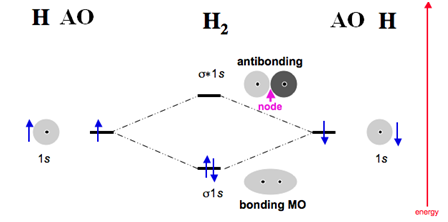
Bond Order = [2-0]/2 = 2/2 = 1
Here * represents anti-bonding orbital.
MOs of He2 Molecule:
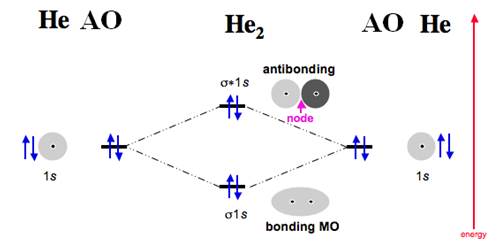
Bond Order = [2-2]/2 = 0/2 = 0.
As the BO is zero, there is no bond between He 2 molecule. This means He is monoatomic molecule.
MOs of Li2 Molecule:
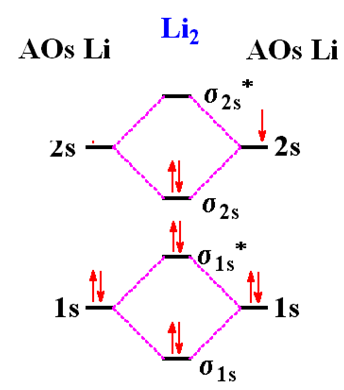
Bond Order = [4-2]/2 = 2/2 = 1