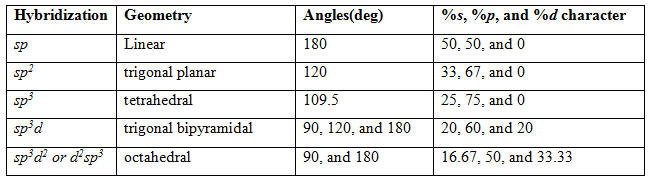
Different molecules having same hybridization but acquire different shape. To explain these phenomena in 1957 Gillespie and Nyholm provided a theory that is known as Valence Shell Electron Pair Repulsion Theory (VSEPR theory).
Valence Shell Electron Pair Repulsion (VSEPR) Theory:
(i) Lone pairs of electrons (lp) repel each other more strongly than that of bond pair (bp) of electrons. The decreasing order of repulsion is lp - lp > lp - bp > bp - bp.
Examples:

- In CH4 only bp-bp repulsion exist while, in NH3 two types of repulsive force present, lp - bp repulsion and bp - bp repulsion. lp - bp repulsion dominates over bp - bp repulsion. Because of this the bonds in NH3 is more compressed than that in CH4 which provides lower band angle in NH 3 .
- In CO2 the central C atom does not occupy any lone pair of electron, hence in CO2 only bp - bp repulsion exists. The central S atom in SO2 contains one lone pair of electron. Therefore, in SO2 lp - bp repulsion and bp - bp repulsion present. As we know that lp - bp repulsion dominates over bp - bp repulsion, the O-S-O bonds is compressed by dominating lp - bp.
- NO2+ does not contain any paired or unpaired electron on the central N atom. Here, only bp - bp repulsion exists. In NO2 the central N atom contains one unpaired electron, while in NO2− the N atom contains one lone pair of electrons. As in NO2 only one unpaired electron present, the lp - bp repulsion is lower compared to lp - bp repulsion in NO2− . Hence, the dominating lp - bp is more pronounced in NO2− compared to NO2 .
(ii) Repulsion between bond pairs decreases as the electronegativity of the atom bound to the central atom increases.
A bond is formed by the sharing of electrons. When the difference in electronegativity between the two connecting atoms increases the electron pair is shifted towards the more electronegative atom. With increases of electronegativity this shift is more to the electronegative atom. This decreases the repulsion effect between two bond pairs.

- F is more electronegative that that of H. Therefore, compared to NH3 , in NF3 the bond forming lone pair of electron is more shifted to the F atom. This decreases bp - bp repulsion. Therefore, in NF3 the lp - bp repulsion is more predominating that that of NH3 and makes F-N-F bond angle 102° compared to H-N-H bond angle 107.3° .
- Same (above) argument is valid for having higher H-O-H bond angle in H2O compared to F-O-F bond angle in OF2 .