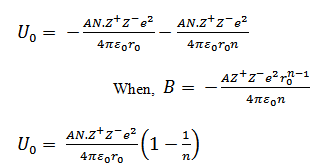
The minimum in the curve (Figure) corresponding to the equilibrium situation (where r = r 0 ) and the energy can be given as;

 |
(2) |
The equation (2) is known as Born-Landé equation. It allows lattice energy calculation from the knowledge of geometry of a crystal, Madelung constant, inter atomic distance, and charge of the ions.
Important points arise from the Born-Landé equation:
(I) Lattice energy is inversely proportional to the interionic distance. Therefore, lattice energy of a system increases as the interionic distance decreases.
(II) Lattice energy id directly proportional to the product of ionic charges. Hence, lattice energy increases with the increase of ionic charge product.
Example: LiF (Both Z + = Z − = 1), U 0 = - 1004 kJ mol −1
MgO (Both Z + = Z − = 2), U 0 = - 3933 kJ mol −1
Further understanding to the stability of a lattice:
Born-Haber cycle:
Lattice energy cannot be measured experimentally. They are calculated from the other experimental data using Born-Haber cycle. The theoretical and experimental data are quite close as obtained using Born-Haber cycle.
Let us consider NaCl lattice.
NaCl is a ionic compound composed of Na + and Cl − ions.
We can consider the NaCl formation stepwise;
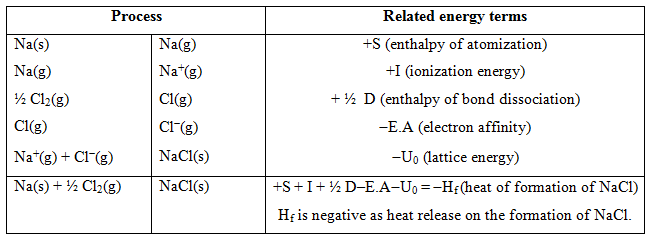
Hence, U 0 = +S + I + ½ D –E.A+H f
The lattice energy can be calculated from the other experimental data with the help of Born - Haber cycle.