Lattice energy:
The energy of the crystal lattice of an ionic compound is the energy released when ions in gaseous stare come together from infinite separation to form a solid crystal.
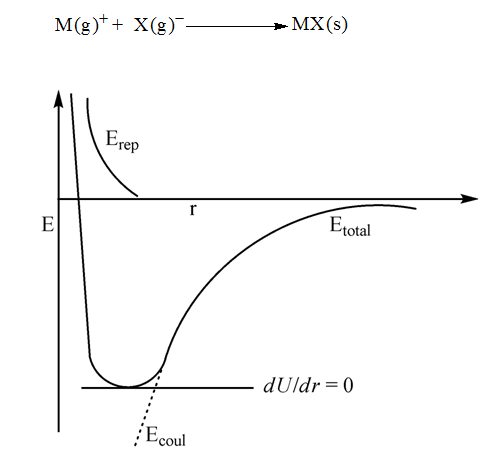
Figure 2.10. Energy curves for an ion pair.
Consider the energy of an ion pair, M + , X − , separated by a distance r . The electrostatic energy (E coul ) of attraction is obtained from coulombic law;
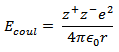
Since one of the charges is negative (X − ), the energy will be negative with respect to the energy at the infinite separation. The magnitude of the negative energy increases as r decreases.
In a crystal lattice, one ion is surrounded by several others counter ions. Therefore, both attraction and repulsion forces also exits. The summarization of all these geometrical interactions is known as the Madelung constant, A. The energy equation then becomes;
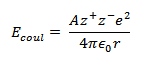 |
(1) |
The evaluation of the Madelung constant (A):
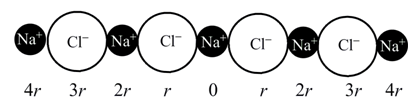
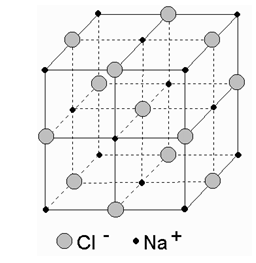
Let us consider NaCl Structure. The central Na + ion is attracted by two Cl − ion at r and two more Cl − ions at 3 r . The corresponding contribution to the potential energy would be then - 2e 2 /4 π ε° r and - 2e 2 /4 π ε° 3 r, respectively. At the same tome there will be repulsion from sodium ions residing at 2 r for two and at 4 r for two. This will raise the potential energy with the contribution of +2e 2 /4 π ε° 2 r and +2e 2 /4 π ε° 4r, respectively. The procedure can be reported for the other ions present in a row. The potential energy for the centralNa + ion will be then;
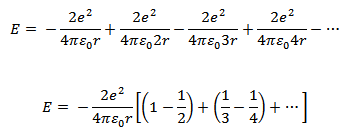
This procedure many be extended for the three dimensional lattice of a NaCl crystal.