Introduction:
The stability of the monoatomic noble gases emphasized the fact that an atomic system with eight outer most electrons (two for He) will be very stable and called as noble gas configuration. This is also known as octet rule. The above statement can be further described for the inclusion of He as, the atomic system with filled outermost shell will be stable.
Atoms are connected to another homo - or hetero - atom(s) forming molecules, while, molecules of noble gases are monoatomic. This indicates that a molecule will only be formed by the combination of either homo - or hetero - atom if it tends to a low energy, filled-configuration of the outermost shell, and more stable systems than individual atomic systems.
In a di or polyatomic molecules, atoms are held together by means of an attraction force. This force is called bond. A bond could be formed by equal sharing of electron density between atoms (covalent bonding), or uneven sharing of electron density together with coulomb interaction between the atoms (ionic bonding). Whatever, a stable electronic configuration should be achieved by atom either by releasing/accepting electron(s) or sharing electron(s).
The inter-nuclear distance between two atoms is known as bond distance. The bond dissociation energy is the enthalpy change for complete splitting the units linked by a particular chemical bond in the gaseous state. It is also defined as the amount of energy released when the bond is formed between two neutral gaseous atoms.
Types of bonds:
Elements can be subdivided mainly into two groups; electropositive and electronegative elements. Those elements which release or accept electron(s) to achieve an inert gas configuration are called electropositive and electronegative elements, respectively. Combination of electropositive and electronegative elements forms the following compounds.
(A) Ionic compounds = Ionic bond = Electropositive elements + Electronegative elements
(B) Covalent Compounds = Covalent bond = Electronegative elements + Electronegative elements
(C) Metallic Compounds = Metallic bond = Electropositive elements + Electropositive element
Examples:
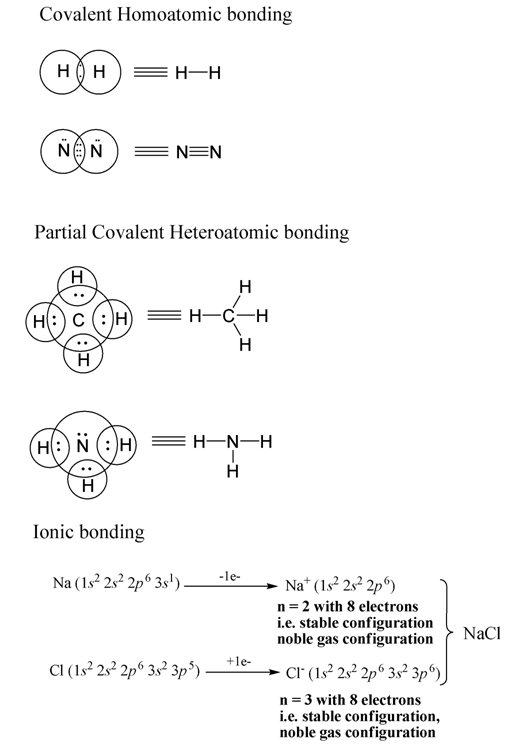
Figure 2.1. Covalent, partial covalent and ionic bonding patterns maintaining octet rule.