1.7.3.13. Role of Remote Hybridization on the Kinetics of BC
Basak et al. designed the following pyridazinedione-based enediynes containing remote sp2 hybridized “C” to demonstrate the role of remote hybridization on the kinetics of BC (Scheme 36).
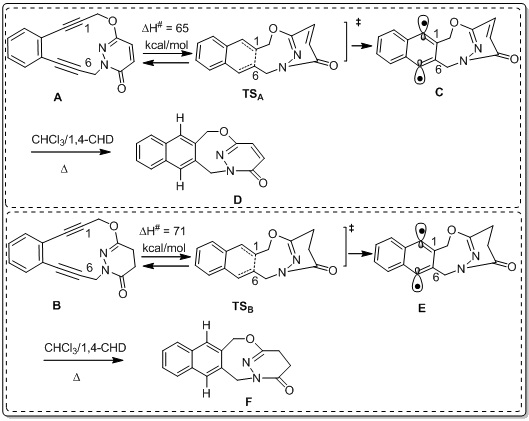 |
Scheme 36. Formation of Bergman cyclised products from A and B |
By studying the DSC onset temperature that is the signature of temperature of BC, solution phase kinetics and semiemperical PM5 calculation they observed that saturation of the double bond speeds up the reaction of BC that can be exploited to use this as a triggering mechanism.
1.7.3.14. Effect of p-Stacking and Charge Transfer Interaction on the Kinetics of BCIntermolecular charge transfer (CT) complexes arising from the interaction of aromatic  and acceptor molecules have been studied extensively. However, fewer intramolecular CT analogues have been reported, primarily of the cyclophane type, in which the donor and acceptor portions are locked together in a rather rigid arrangement. More flexible intramolecular CT complexes have been reported in a recent communication, whereby a cyclohexane skeleton is substituted at adjacent trans positions with aromatic donor and acceptor groups. Besides charge transfer interactions, attractive nonbonded interactions between aromatic units (
 -stacking) play a central role in many areas of chemistry and biochemistry as discussed earlier. The activity profiles of the well-known medicinally important enediynes are greatly perturbed by weak interactions. Jones et al. have shown that the strong electron-withdrawing groups increase the barrier for Bergman cyclization, while
 -donating groups decrease it whileconjugation, especially, donation, has little effect. Alabugin in a recent paper evaluated the stereoelectronic effects in cyclohexane, 1,3-dioxane, 1,3-oxathiane and 1,3-dithiane based enediynes. Zaleski et al. have shown how dramatically the steric influences of the functional groups at the termini of acyclic enediynes can affect the Bergman cyclization temperatures of the resulting compounds.
That the perturbation can be a cause of metal ligand charge transfer transition as was shown by Zaleski et al., may be extended to the charge transfer between the organic donor and the acceptor moiety hooked into the two arms of the acyclic enediyne or possible -stacking interactions between the two donor moieties in both the arms. As the charge transfer or -stacking interaction occurs, the two arms may possibly come closer. This should lower the distance between two reactive acetylenic bonds and thus elevation rates of BC can be expected. With these ideas in mind we framed our objectives as stated below.
To elaborate the concept of weak interactions and their effect on Bergman Cyclization (BC), Basak et al. synthesized several enediyne compounds of general structures, as in the Figure 19, incorporating Donor and Acceptor units in the two arms of enediynes and followed their charge transfer/-stacking interactions by studying UV/VIS spectroscopy.
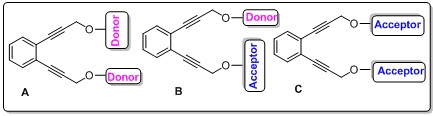 |
Figure 19. Representation of donor-acceptor containing enediynyl compounds. |
Specifically, their intention was to investigate the possibility of encouraging Bergman Cyclization (BC) by pulling the reactive centers together with, if possible, CT / -stacking interactions between the two arms of the enediynes. As was discussed earlier, among the various parameters that control the kinetics of BC, the distance between the acetylenic carbon atoms undergoing covalent connection (c,d-distance), has become extremely useful in spite of some limitations. As compared to the cyclic ones, acyclic enediynes have a comparatively high c,d-distance, which is much above the critical distance range required for spontaneous cyclization as proposed by Nicolaou and others. However, it is not unreasonable to think that similar to enediynyl amino acids and peptides (Scheme 29, Figure 16), acyclic enediynyl compounds containing the donor and acceptor moieties in the two arms, may involve in through-space intramolecular charge transfer (ICT) interaction and the -stacking interaction between them. This should lower the c,d-distance and hence the activation barrier for cycloaromatization. Thus, they have synthesized the following compounds shown in Figure 20. As the donor units, electron rich aromatic compounds like naphthalene or derivative of naphthalene (containing electron donating substituent) and anthracene derivatives were employed. Benzene derivatives with strong electron withdrawing groups like -NO2, -CN, -CF3, were used as acceptor moieties.
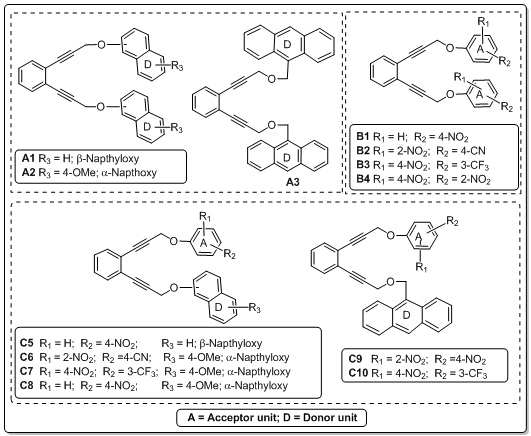 |
Figure 20. D/D, D/A and A/A containing enediynes |
They have demonstrated that charge transfer or -stacking interactions can enhance the cyclization kinetics. Repulsion between electron deficient partners raises the activation energy. While the D/A enediynes become activated because of CT-interactions, the enediynes with D/D arms also show greater reactivity than the corresponding A/A counterparts possibly because of -stacking interaction.