1.7.3.12.2. Role of Hybridization in Unnatural Enediynes
Magnus and co-workers were the first to study the dependence of reactivity of enediynes with the state of hybridization. They had prepared bicycle [7.3.1] enediyne analogues and showed that the enediyne ring of A (Scheme 30) was resistant to cycloaromatization at ambient temperature, but reacted slowly at 82°C to form the corresponding benzenoid product. A change in hybridization of the one-carbon bridge (C-13) from sp2 to sp3 (A to B) was shown to effect a dramatic increase in the rate of cycloaromatization. Thus, enediyne B undergoes complete cycloaromatization at 20°C within 30 min. Hence, it is evident that changing C-13 from trigonal to tetrahedral geometry considerably lowers the activation barrier for BC.
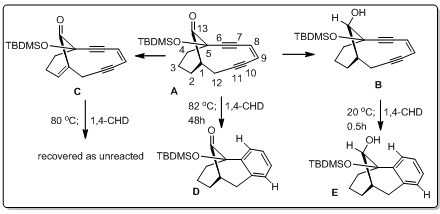 |
Scheme 30. Effect of hybridization on the rate of BC (Magnus et al.). |
Magnus et al. have also introduce a bridgehead double bond (C-1,2) to see the effect on the rate of diyl formation. Thus they have synthesized C from A and got a mixture of C and unreacted A. Though they could not be separated by chromatography, merely heating the mixture of C and A at 80 oC, in presence of 1,4-cyclohexadiene converted A into the less polar benzenoid adduct D while C was recovered unchanged. This study reveals that changes in hybridization at the bridging carbon (C-1) dramatically change the rate of diyl formation and also able to show that the bridgehead sp2 carbon retard the rate of cyclization dramatically.
In 1989, Magnus et al. have shown that the comparatively unreactive enediyne C undergoes cyclization after removal of the C1-C2 double bond. Thus heating C at 110oC in 1,4-CHD in the presence of 4-chlorothiophenol and N-morpholine gave the aromatized product G (Scheme 31). This result convincingly demonstrate that the formation of putative 1,4-diyl can be triggered intermolecularly by thiol addition to C-2 and provides an alternative triggering device that may be exploited in the design of so called rational analogs and also the importance of double bond on the rate of cyclisation.
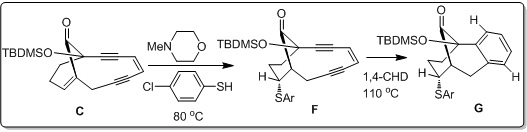 |
Scheme 31. Effect of hybridization on the rate of BC (Magnus et al.). |
During the study of relative rates of cycloaromatization of Dynemicine azabicyclo[7.3.1]enediyne core structures, Magnus et al. showed an interesting role of hybridization of bridging carbon atom on to the cyclisation barrier. They have synthesized and studied the rates of BC of several dynemicine core structures. Thus, while distance between the bonding acetylenic carbon atoms in H and L is virtually the same, and the hybridization at the bridging carbon atoms is trigonal in both compounds, L cyclises 500 times faster than H at 37oC. They have found an even more dramatic change in rate when the bridging trigonal carbon atom is made tetrahedral. Thus reduction of H with sodium borohydride in methanol at 25oC gave directly the cycloaromatized alcohol K. Conservative estimation showed that the alcohol J cycloaromatizes 106 faster than H at 37oC (Scheme 32).
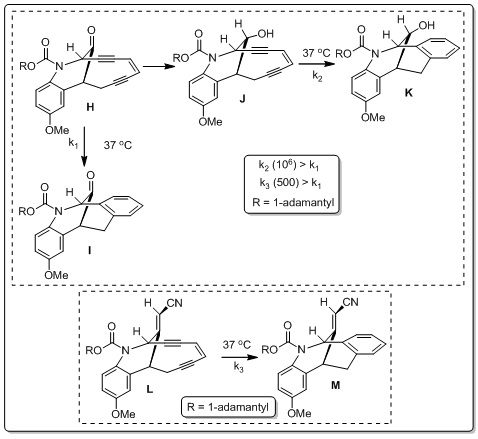 |
Scheme 32. Effect of hybridization on the rate of BC Magnus et al. |
Annelation of a bicyclo [7.3.1] enediyne core has been shown by Nantz et al. to alter the cycloaromatization reactivity. The enediyne (O) containing a sp3-hybridized bridging carbon atom is resistant to cycloaromatization whereas the immediate sp2-hybridized precursor enediyne (N) readily undergoes transformation to its benzenoid counterpart (Scheme 33). This observation is just opposite to the study of Magnus but give the light about the role of hybridization on the rate of BC.
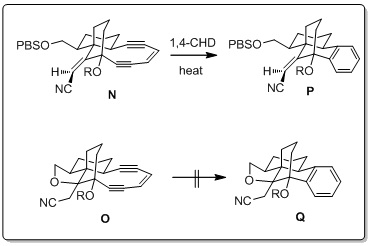 |
Scheme 33. Role of annelation and hybridization on BC |