1.7.2 Importance of BC in Biology
The BC is perhaps one of the few reactions that was discovered but did not get much attention before their counterpart was discovered in Nature. The reason for the nonexploitation of the reaction is probably the necessity of high temperature. No one could foresee that the same reaction would be possible under ambient conditions until Mother Nature showed the way to do it through the chemistry of the natural enediynes. In the mid to late 1980s, it became clear that an emerging series of naturally occurring antibiotics, including calicheamicin, esperamicin, and dynemicin, all operated via Bergman cyclization to a p-benzyne derivative, followed by H atom abstraction, especially from DNA. As a consequence of the antibiotics becoming cycloaromatized, the cell under chemical attack suffered DNA cleavage, ultimately leading to cell death. Therefore, the BC is at the heart of the chemistry of enediynes and is primarily responsible for their biological activities. Understanding the parameters controlling BC kinetics is of paramount importance for the design of any new enediyne.
The strong DNA-cleaving activity of these molecules led to the synthesis of many nonnatural targets containing the active enediyne “warhead” of the antibiotics. All the natural antibiotics, as well as the synthetic mimics, possess an enediyne unit within a medium ring of 9-10 atoms, thus incorporating the strain necessary to enable the cyclization to occur at biologically relevant temperatures. Most of these systems are polycyclic, and contain other adjustable strain-inducing elements, as well as triggering devices that can release a more reactive form of the enediyne upon activation. The utility of this strategy lies in retaining the enediyne in prodrug form until it reaches its biological target, following which the active drug is unveiled. Although several of the naturally occurring enediynes are undergoing clinical evaluation, efforts to produce comparable designed enediynes remain a formidable challenge because of problem in controlling reactivity of enediynes. It is therefore highly desirable to determine the factors that govern the cyclization step.
1.7.3 Parameters that Control the Kinetics of BC
Research in the fifteen years or so has enabled us to understand some of the controlling parameters for BC kinetics. From the very inception of its discovery, BC is known to have high activation barriers for acyclic enediynes (Scheme 15). Cyclic enediynes, on the other hand, generally have much lower activation energy so that the same reaction can take place at a lower temperature. For example, a 10-membered carbocyclic enediyne (P) or a heterocyclic enediyne (N or O analogue, structure R and T respectively) undergoes cyclization at ambient temperatures with fairly decent half-lives (except the sulfur analogue V which is stable at room temperature). Fusion of strained rings on to the cyclic enediynes (examples X-Z) brings back the stability (Scheme 15). Incorporation of strain raises the energy of the transition state more than that in the ground state thus elevating the activation barrier for BC.
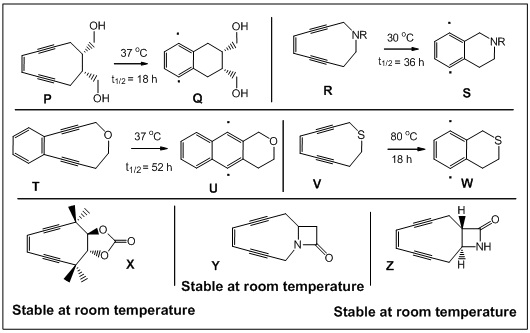 |
Scheme 15. Some examples of stable and unstable enediynes.
|
To ascertain what exactly prompted these molecules to readily undergo BC, studies were undertaken in various laboratories. Several theories have been put forward which are described here.
1.7.3.1. Nicolaou’s Distance Theory
On the basis of his extensive studies, Nicolaou et al., in 1988, proposed that the distance between the terminal acetylenic carbons of the enediyne group (d) is a major determinant of reactivity, and the values of d between 3.20 and 3.31 Å would be necessary for their biologically relevant reactivity. Nicolaou et al. also found that while the cyclic enediynes (n = 3-8; Figure 10) were stable at room temperature, the 10-membered analogue (n = 2) having an c,d-distance of 3.25 Å undergoes cyclization at 37oC with a t1/2 of 18 h (Table 1).
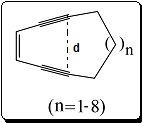 |
Figure 10. Cyclic enediynes by Nicolaou et al. |
Table 1. Calculated c,d-distances and stability of conjugated enediynes
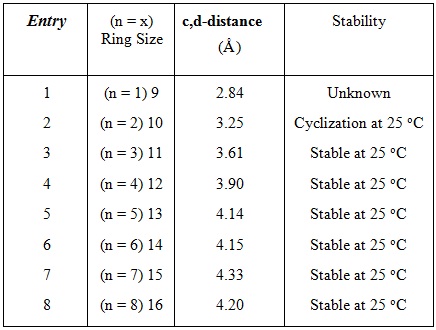
Recently, Schreiner using the Density Functional Theory (DFT) estimated the activation enthalpies for the BC of a series of cyclic hydrocarbon enediynes and extended the “critical range” of 3.31-3.20 Å for spontaneous cyclization to 3.40-1.90 Å.
1.7.3.2. The Molecular Strain Theory
In contrast, to Nicolaou’s hypothesis, both Magnus et al. and Snyder argued that differential molecular strain between the endiyne and transition states is the commanding element for ring closure. It also considered the transition state for the BC as product like. This was substantiated by experimental observations (activation energies and X-ray structures of a few C9-C12 cyclic enediynes) and by empirical computations. As for example the enediyne A with a greater c,d-distance undergoes faster cyclization compared to B with a smaller c,d-distance (Scheme 16).
Although the molecular strain theory seems more quantitative, Nicolaou’s theory has been used more frequently because of its simplicity. In recent years, DFT-based calculations lent support to the distance theory; only the range of critical c, d-distance has been modified and calculated to be 3.40-2.90 Ǻ.
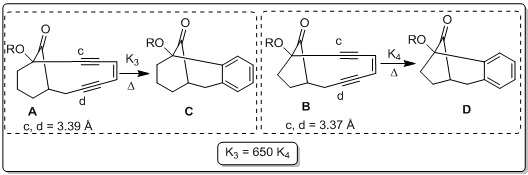 |
Scheme 16. Role of strain energy on the kinetics of BC |